From Shed to Side Hustle — Choosing a Fibre Laser Engraver in the UK
A corner of the garage, one spare 230V socket, and a stream of personalised pet tag orders arriving from Etsy UK—more than a few British side hustles have started from exactly that setup, and most of them run on a fibre laser engraver. But shopping for your first fibre machine means wading through wavelength charts, pulse widths, and acronyms that nobody explains in plain English. This guide starts where UK buyers actually start: what the machine will earn, where it will live, and which of the intimidating terms on the box genuinely change what you can make. By the end you'll know how fibre laser engraving differs from the CO2 machine in the shed, when MOPA technology justifies its premium, and which machine in OMTech's UK lineup matches the side hustle you have in mind.

The One-Paragraph Answer
A fibre laser marks bare metal—stainless steel, aluminium, brass, silver, titanium—faster and with more contrast than any CO2 machine ever will, with no consumables beyond electricity. If your plans involve pet tags, jewellery, tools, or anything with a name on it made of metal, fibre is the tool. The rest of this guide is the reasoning, the workshop realities, and the machine picks.
Section 01
Why British Makers Add Fibre to the Bench
The UK's maker economy has a particular shape: a huge appetite for personalised gifts on Etsy UK and Not On The High Street, a strong tradition of local trade work—recovering van signs, tool marking for tradespeople, club and team kit—and customers who will happily pay a premium for something engraved rather than printed. Metal sits at the heart of most of that work, and metal is exactly where a CO2 machine runs out of answers.
The physics, briefly: a fibre laser operates at 1064 nanometres, a wavelength that bare metal absorbs readily, while the 10.6-micron beam of a CO2 laser mostly reflects off it. Different job, different tool. If you're starting from zero, our guide to choosing a laser engraver for metal in the UK walks the wider landscape; the sections below assume fibre is on your shortlist and focus on which fibre machine and why.
Section 02
Q-Switched or MOPA — Matching the Source to the Work
Every fibre laser you'll consider is built around one of two pulse technologies, and the choice matters more than the wattage sticker:
- ▸ Q-switched machines produce short, fixed pulses—the dependable choice for everyday marking. Serial numbers, pet tags, tool branding, anodised aluminium, deep black marks on stainless: a Q-switched galvo unit handles all of it, at a friendlier price.
- ▸ MOPA machines let you adjust the pulse width and frequency independently. That adjustability unlocks colour marking on stainless steel—heating the surface to controlled oxide colours rather than ablating it—plus gentler handling of thin or delicate stock. For a full technical comparison, our MOPA vs. non-MOPA fibre laser guide covers the details.
The honest UK-market advice: start Q-switched unless colour marking is your product, not just your party trick. A starter galvo unit pays for itself faster than a MOPA does, and you can step up once the orders justify it.
Section 03
Power, Fumes and Winter — Setting Up a Shed or Garage Bench
This is where UK workshops differ from the showroom ideal, and where a little planning saves a lot of regret. Four realities of the British shed or garage bench:
- ▸ Power is the easy part. Fibre engravers in the desktop and benchtop class run from a standard UK 230V socket—no three-phase supply, no electrician visit for the starter machines. Reserve a clean socket and keep extension leads short.
- ▸ Footprint favours galvo units. A galvo fibre engraver takes roughly the footprint of a small microwave, which is precisely why it suits the British shed so well—browse the fibre and MOPA laser collection and check the dimensions against your bench before falling in love with anything.
- ▸ Fumes don't care how small the space is. Metal marking produces fume you should never breathe, and a shed concentrates it fast. Ventilate properly with a fume extraction system sized for the room, and read our exhaust setup guide before your first mark, not after.
- ▸ Winter is the enemy of optics. An unheated shed swings through the dew point on cold mornings, and condensation settles on the galvo lens and mirrors. Let the machine reach room temperature before powering on, keep silica gel in the enclosure, and consider a small tubed heater on a thermostat for the coldest months.
-

Section 04
Three Side Hustles and the Machine for Each
Rather than a spec ladder, match the machine to the money. Three side hustles cover most UK buyers, and each points to a different machine:
Hustle 1 — Personalised Pet Tags and Small Metal Gifts
The classic UK entry point: engraved pet tags, keyrings, and small keepsakes sold on Etsy UK and at fayres. A 30W galvo fibre laser with autofocus marks a stainless tag in well under a minute, and the economics are forgiving. An illustrative worked tag, priced with the ÷0.6 margin formula:
| Line Item | Cost (GBP) | Notes on the Maths |
|---|---|---|
| Stainless tag & ring | £1.10 | Illustrative blank cost at hobby quantities |
| Bench time (4 minutes) | £2.00 | Marking plus setup and finishing, at £30/hour |
| Packaging & selling fees | £1.40 | Envelope, jiffy bag, and platform fees |
| Total unit cost | £4.50 | Materials plus time plus fees |
| Shelf price (÷0.6) | £9.99 | The formula lands at £7.50; personalisation carries the premium to £9.99 |
Roughly £5.50 of margin a tag means a few hundred orders—very achievable across Etsy UK, fayres, and local vet and pet shop referrals—separates the machine from your credit card. Results vary with your pricing and volume, but the maths is the reason pet tags are the UK's most-recommended first fibre product.
Hustle 2 — Jewellery and Colour-Marked Premium Pieces
Once colour on stainless and titanium becomes part of your product range—anniversary pieces, club jewellery, branded keepsakes—a MOPA earns its premium. The 30W MOPA fibre laser covers colour marking and delicate work at a desktop footprint, while the 60W MOPA fibre laser adds speed for growing order books. Our guide to fibre laser metal marking for UK workshops shows what these machines do on real stock.
Hustle 3 — Local Trade and Business Marking
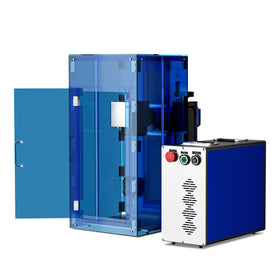
The under-discussed route: tradespeople, gyms, breweries, and small manufacturers all need tools, badges, signage, and parts marked, and they pay business rates for reliability. A dual-source machine like the OMTech Solis Duo 30W fibre and 20W diode laser covers bare metal and coated or organic stock in one box—a genuine space-saver for a one-bench workshop—while production-scale work graduates to the OMTech FC-22 fibre laser. Add a rotary axis and drinkware and cylindrical work join the menu; our guide to engraving powder-coated tumblers in the UK is the natural next read.

Section 05
Answers UK Buyers Ask Before They Buy
Do I need special electrics for a fibre laser?
Not for the desktop and benchtop class—a standard UK 230V socket runs them comfortably. Larger cutting-class machines are the exception, so check the specification sheet before ordering if your plans involve production equipment rather than an engraver.
Will a cheaper diode machine do the same job?
On coated metals, sometimes. On bare stainless, brass, or silver, no—a diode's wavelength largely reflects off bare metal, which is precisely the surface fibre machines dominate. If bare metal is your product, buy fibre once rather than buying diode twice.
Is a fibre laser safe to run at home?
With the enclosure closed, extraction running, and the supplied safety glasses worn by everyone in the room, yes—that's how they're designed to be used. Treat the machine as Class 4 laser equipment regardless of how tidy the bench is, keep the interlocks intact, and keep pets and children out of the shed while it runs.
How does the machine cope with a British winter?
The electronics are unbothered; the optics are not fans of condensation. The routine is simple: on a cold morning, bring the machine to room temperature before switching on, keep moisture absorbers in the work area, and wipe down the lens before your first job of the day. Fibre machines have no water system to freeze, which makes them more forgiving than CO2 machines in cold outbuildings.
Section 06
Your First Mark Is Closer Than You Think
The gap between "thinking about it" and a working UK side hustle is smaller than it looks: a benchtop fibre machine, a fume extractor, a box of stainless blanks, and one product you can mark better than the marketplace average. If you want to go deeper on the technology before committing, our explainer on how fibre laser engravers work covers the science without the jargon.
Order the blanks, clear the bench, and run your first test file within an hour of the machine arriving—the makers who start marking on day one are the ones with a product page live before the month is out.