

Should You Get a 90W CO2 Laser Engraver?
If you regularly cut materials around 1/4 inch or thicker, need to complete batches more quickly, have outgrown the workspace of a smaller laser engraving machine, or plan to run your machine for several hours a day, a 90W CO2 laser is very likely the upgrade that you need.
Lower-wattage desktop laser engravers are excellent for hobby projects and lighter materials, but when you are looking for a dedicated laser engraver for business, a 90W CO2 laser engraver should be the first on your list.
But more power does not automatically mean a 90W laser is the right choice for everyone. These machines are larger, require more space and supporting equipment, and may not be the best option for highly detailed engraving on delicate materials.
So, should you get a 90W CO2 laser engraver?

What a 90W CO2 Laser Can Actually Do? A Closer Look
The main advantage of a 90W CO2 laser engraver is that it gives you significantly more capacity for cutting thicker materials and completing larger or higher-volume jobs.
In fact, the consensus in the laser engraving world is that 90W is the ultimate "crossover" power for a laser engraver: capable of professional cutting capacity while maintaining just enough lower-end nuance for block engraving.
In general, you can expect a decent 90W CO2 laser machine to be capable of high-speed vector engraving up to 600–1,000 mm/s and single-pass cutting of materials up to 1/2-inch (12mm) thick.
Of course, the actual performance ( power and speed) differs depending on the nature and thickness of the material being engraved, as well as the make and model of the machine.
90W CO2 Laser Engravers: Quick-reference snapshot:
| Capability | 90W CO2 Performance |
| Sustainable engraving speed | 300–600+ mm/s (top-rated frames can push toward 1,000 mm/s) |
| Single-pass cutting depth | Up to 1/2" (12mm) |
| Minimum firing threshold | 10% power (9W) |
| Best for | Thick material cutting, high-speed batch work |
| Weaker at | Delicate photo engraving, ultra-fine detail on soft materials |
Explore this complete laser engraving speed chart for more context.
90W CO2 Laser Engraving and Cutting Performance in Depth
1. Engraving Speed: Rated vs. Realistic
Most 90W CO2 laser engravers are listed as being able to engrave up to a top speed of 1,000mm/s, but it's generally not advisable to pay much attention to this number. That is because there's a difference between how fast a laser engraver can operate and how fast it should operate.
Depending on the chassis rigidity, a 90W CO2 laser engraving machine can engrave healthily and long-term at maximum speeds between 300 mm/s and 600+ mm/s.
This isn't to say a laser engraver can't reach that top speed: some heavy-duty gantries can safely push to 1,000 mm/s without gantry vibrations causing double images or "whiplash" artifacts. But these are not the majority.
There are many things to know about CO2 glass laser tubes, and one of the most important is that they require a minimum power threshold to ignite the gas inside, typically around 10% (9W for a 90W tube).

Keep in mind that even this lowest setting is still quite powerful, especially if you're doing delicate engraving on softer materials: a 90W laser will struggle with soft, highly detailed photo engraving on materials like paper or light leather, since it easily scorches or burns through the material.
2. Cutting Thickness and Material Capacity
Cutting speed and material depth are the two areas where a 90W CO2 laser engraver shines brightest. With a 90W laser, typical single-pass limits include:
| Material | Thickness | Speed | Power |
| Plywood / MDF | 3mm (1/8") | 40–55 mm/s | 60–70% |
| Cast Acrylic | 6mm (1/4") | 15–20 mm/s | 65% (flame-polished edge) |
| Plywood | 10–12mm (1/2") | 5–8 mm/s | Up to 75% |
Why Upgrade to 90W CO2 Laser Engraver? The Core Benefits
The primary benefit of a 90W CO2 laser, especially over lower-power options (like 40W–60W), is vastly superior cutting speed and the ability to cleanly cut through thick, dense materials in a single pass. This makes a huge difference if you're in commercial or high-volume production.
1. Faster cutting, greater material capacity.
While lower-power lasers (like a 40W K40 or 55W machine) struggle or fail to cut anything past 1/4-inch (6mm) wood ( at least without charred edges and multiple passes), a 90W laser slices through 1/2-inch (12mm) plywood or acrylic in a single pass with clean results.
So, if you are working with common wood, acrylic sizes like 1/8-inch (3mm) or 1/4-inch (6mm) materials, a 90W laser operates up to 2 to 3 times faster than a 50W laser.
This speed multiplier is crucial, especially for smoothly and efficiently running an Etsy shop or small manufacturing business where time directly equals profit.
2. Larger work areas for larger projects.
90W CO2 laser engravers require 90W laser tubes, which are physically longer (usually around 1200mm to 1400mm).
This forces the machine to have a much larger cabinet and gantry footprint (typically 24" x 35" or larger); a bigger workbed gives you far more versatility in the sizes, types, and amount of materials you can work on at any given time.
These machines are also classified as commercial equipment, so manufacturers are required to build them with upgraded components like linear guide rails, heavy-duty stepper motors, and Ruida digital controllers, making them significantly more reliable for long, continuous jobs than hobbyist desktop models built with cheaper materials.
3. You can Extend the Lifespan of the Tube by Under-Driving
The longer a laser engraver runs at max capacity (or close to it), the shorter its lifespan becomes. To cut a piece of 1/4-inch wood, a 50W laser has to run at 90–100% capacity, rapidly degrading its glass tube.
A 90W laser can comfortably perform the same cut at a low 40–50% power setting.
This "headroom" means the tube runs cooler and lasts thousands of hours longer than a lower-power machine being constantly maxed out.
4. You are (Almost) Guaranteed a Better return on investment.
A common narrative in the laser engraving world is the "buy nice or buy twice" cycle, and a 90W CO2 laser engraver fits it well. There are almost unlimited options to make money with a laser cutter when you have a 90W machine, and you are almost guaranteed to have a positive ROI in the long term.
Starting at 90W means you skip the expensive, tiring, and uncertain process of selling hobby gear to upgrade to a commercial setup later; a good number of people start with a 40W or 60W machine and outgrow its cutting limits within six months.
Is a 90W CO2 Laser Right for You? 4 Signs You Need to Upgrade
You know you need to upgrade when your current hobby setup starts creating bottlenecks, limiting your material choices, or slowing down order fulfillment. In fact, in the laser engraving community, the jump from a desktop laser (like a 40W or 55W) to a 90W machine is generally seen as the official transition from hobbyist to professional creator.
Upgrade to a 90W CO2 laser if:
1. You regularly cut materials thicker than 1/4 inch.
With a 90W CO2 laser, you can handle many, if not all, of the best woods for laser engraving or cutting. Even if you routinely cut 1/2-inch (12mm) plywood, MDF, or thick cast acrylic, lower-wattage lasers will require multiple passes and leave you dealing with heavy charring, sticky residue, and warped edges.
A 90W laser slices through 1/2-inch material cleanly in a single pass, and it's also worth it for dense woods like oak, walnut, or cherry that sap a lot of laser energy, or for thick wood signage, furniture components, or structural pieces.
2. Your business is bottlenecked by production time
A 90W machine is also an excellent model of a laser engraver for Etsy shops. If you run an Etsy shop or a local manufacturing business and are turning down orders because your current laser takes hours to complete a single batch, a 90W laser will drastically shorten fabrication times and let you scale daily output.
With the power, capacity, and workspace of a 90W laser, there is no limit on what to sell on Etsy: it cuts standard 1/8-inch (3mm) or 1/4-inch (6mm) materials two to three times faster than a 45W or 50W machine.
3. You need a larger work area
90W machines typically feature expansive workbeds (usually 24" x 35" or larger). This matters if you're tired of manually cutting large sheets of plywood down into small squares just to fit them inside a small desktop laser bed.
4. You plan to run your laser for several hours a day.
Running a 50W laser at 90% power to cut plywood all day will burn out the tube within months. A 90W laser achieves those same cuts at only 40–50% of its maximum power, keeping the tube cool with minimal stress- ideal for multi-hour daily operation.
You should stick with a 50W or 60W machine if:
- Your primary goal is high-detail engraving. 90W tubes have a high minimum firing threshold (around 9W) and can't output the ultra-faint energy needed for delicate grayscale photo engraving, paper cutting, or soft leather marking without scorching the material. You may need to explore more options if your business does a lot of leather laser engraving, for example.
- You have space constraints. These machines weigh several hundred pounds, cannot fit through standard small doorways without being disassembled from their wheel bases, and require industrial water chillers (like a CW-5200) and external ventilation.
Top-Class OMTech 90W CO2 Laser Engraver For Businesses
If you've decided a 90W CO2 laser is the right power level for your projects or business, the next step is choosing a machine with the right combination of workspace, cutting capability, controls, focusing features, and supporting equipment.
OMTech offers several 90W CO2 laser configurations for users who need more than a basic desktop laser can provide.
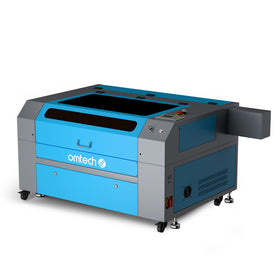
OMTech Pronto 40 90W CO2 Laser Engraver and Cutter
The OMTech Pronto 40 90W CO2 Laser Engraver and Cutter is designed for users who need a spacious work area and the ability to process larger materials. It features a 24" × 35" workbed, giving you considerably more room for large signs, panels, multi-piece layouts, and production runs.
Its front and back pass-through doors are particularly useful when your projects extend beyond the physical dimensions of the workbed, giving you flexibility with longer sheets and oversized materials.
The Pronto 40 also includes automatic focusing and compatibility with LightBurn, making it easier to integrate into an established laser engraving workflow, plus an integrated active water-cooling system essential for maintaining reliable performance during regular use.
Best Projects for a 90W CO2 Laser
A 90W CO2 laser engraving machine excels at projects that combine high-speed vector engraving with structural, thick-material cutting: leveraging its large bed size, rapid rastering speed, and deep single-pass cutting power.
| Project Type | Why a 90W Laser Excels |
| Complex multi-layered wood wall art | Tears through 1/8" (3mm) or 1/4" (6mm) plywood panels at 40–50 mm/s. A job taking a 10W diode laser roughly 304 hours can be completed in about 20 minutes on a 90W machine |
| Commercial signage and acrylic LED displays | Cuts thick cast acrylic (3/8"–1/2" / 10–12mm) in a single pass, with high heat melting the edges into a glass-smooth, "flame-polished" finish that needs no post-processing |
| Flat-pack furniture and storage organizers | The large workbed (24" x 35"+) and high wattage make it easy to process full sheets, cutting clean right angles through thick wood for snug interlocking tabs |
| High-volume batch engraving (tumblers and coasters) | Stationary glass tube lets lightweight gantry mirrors move at 600–1,000 mm/s across a fully loaded bed without losing accuracy or shaking the chassis |
Final Thoughts: Is a 90W CO2 Laser Engraver Right for You?
A 90W CO2 laser engraver can be a significant step up from a 40W, 50W, or 60W machine, particularly if your work increasingly involves thicker materials, larger projects, or regular production. Its greater cutting capacity lets you process materials in fewer passes, while the larger work areas commonly found on 90W machines give you more flexibility with larger sheets and multiple pieces.
However, 90W is not automatically better for every application. If your main focus is delicate photo engraving, lightweight materials, or small hobby projects, a lower-power machine may give you better control while taking up less space and requiring less supporting equipment.
The right question isn't simply, "Is a 90W laser more powerful?" It's, "Do my projects and production needs justify a 90W machine?"
For creators, Etsy sellers, small businesses, and professional workshops looking for greater cutting capacity and production flexibility, an OMTech 90W CO2 laser can provide the additional capability needed to take on larger and more demanding projects.
Explore some laser-engraved wood signs and why they are the best for businesses