How Much Does A Laser Engraver For Metal Cost?
The cost of a laser engraver for metal can range anywhere from $600 (for surface marking) up to $1,500–$2,500 (for entry-level true engraving), and $2,500 to $5,000+ (for professional deep-engraving fiber systems).
This is because the price of a laser engraver for metal is strongly proportional to its engraving depth: in other words, the deeper the engraving capacity of a laser engraver for metal, the more expensive it will be.
Without going into many technicalities, the reason is that laser engravers for metal that engrave deeper are much more sophisticated and require more expensive tools, materials, and technologies to produce. So they are inherently more expensive.

What are Laser Engravers For Metal? A Clear Definition
The first step in deciding how much laser engravers for metals cost is to define exactly what constitutes a laser engraver for metal.
When we speak of laser engravers for metals, we are generally talking about infrared or fiber laser engravers. These are termed laser engravers for metal because they can deeply and permanently engrave raw metals like steel, brass, and aluminum.
This is a very important distinction to make, especially for beginners, because the standard, inexpensive diode or CO₂ lasers (usually under $800) cannot deeply engrave raw metal; they simply reflect off the surface or strip paint/anodization away.
To permanently carve or engrave raw metals, you need an Infrared (IR) or Fiber laser engraver.
How Much Do Laser Engravers for Metal Cost? Cost Breakdown by Type
Based on how deeply they can engrave, laser engravers for metal are usually classified into three price tiers: ultra-budget/entry level laser engravers for metal, entry-level desktop laser engravers for metal, and deep engraving/color laser engravers for metal.
1. Ultra-Budget / Entry-Level Portable ($600 – $1,500)
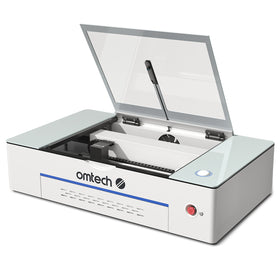
Ultra-budget or entry-level portable laser engravers for metal typically cost up to about $1,500. These are highly compact, low-wattage laser engravers that can handle surface engraving on metal, but they are extremely slow and won't achieve deep structural etches. Consider the following models:
- xTool F1 or standalone 1064nm IR modules: Usually cost around $600 to $1,000 as an upgrade or small portable unit.
- ComMarker B4 (20W) / LaserPecker 3: Found around $1,300 to $1,500. These are entry-level Galvo-head units suited for jewelry and small metal tags.
Budget/entry-level laser engravers for metal are ideal if you are working on a really tight budget, or just a hobbyist experimenting with metal laser engraving. These models are solid and dependable, and are extremely beginner-friendly.
Entry-Level Desktop Fiber ($1,500 – $2,500)
Entry-level desktop fiber lasers typically cost up to $2,500, and this price range typically covers 20W to 30W fiber laser engravers.
This is the price tier mostly recommended if you are starting a hobby or small business. A 20W to 30W Fiber laser handles real metal engraving efficiently. Here are some models to try out:
- This OMTech MOPA 20W fiber laser machine has a 6.9" x 6.9" (175x175 mm) workspace and powerful 20W output at 10,000 mm/s. It effortlessly handles small to medium projects. Whether you are working with brass, carbide, granite, stainless steel, metal, or plastic, this MOPA laser machine not only handles all these materials with ease but also shines at creating stunning color markings.
- Raycus 20W Fiber Laser Engravers: Some Raycus 20W fiber laser engravers are also recommended if you can find them secondhand on marketplaces for around $1,100.

Deep Engraving and Color Marking / MOPA Lasers ($2,500 – $5,000+)
If you want to engrave quickly, etch deep into hard steels, or engrave different colors onto titanium and stainless steel, you need a MOPA fiber laser or a higher-wattage (50W–100W) system. These are usually higher priced, from about $2,500 up to $5,000+.
Consider the following models:
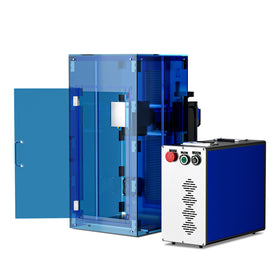
- OMTech MOPA 60W Split Fiber Laser Engraver ($3,899): Comes with a working area of 6.9"x6.9" (about 17.5cm x 17.5cm) and a powerful 60W output combined with high-speed engraving at 10,000mm/s. You can easily handle small to medium projects, catering to various creative needs and allowing your imagination to flourish.
- OMTech MOPA 80W Split Fiber Laser Marker: With 4.3x4.3 in. and 6.9x6.9 in. (11x11 cm & 17.5x17.5 cm) workspaces and a powerful 80W output, this split fiber laser machine easily tackles a range of small to large projects. This 80W fiber laser makes it easy for both beginners and seasoned professionals to start quickly.
Laser Engravers For Metal: Three Price Tiers
| Price Tier | Price Range | Best For | Example Models | Summary |
| Ultra-Budget / Portable | $600–$1,500 | Hobbyists and beginners | OMTech Galvo 30W, xTool F1, ComMarker B4, LaserPecker 3 | Compact, portable fiber lasers for surface metal engraving. Affordable but slower and not suited for deep engraving. |
| Entry-Level Desktop Fiber | $1,500–$2,500 | Hobbyists and small businesses | OMTech MOPA 20W, Raycus 20W | 20W–30W fiber lasers that provide efficient metal engraving with faster speeds and better performance for regular use. |
| Professional MOPA / High-Power Fiber | $2,500–$5,000+ | Professional businesses | OMTech MOPA 60W, OMTech MOPA 80W | High-power systems designed for fast, deep engraving and color marking on metals, making them ideal for commercial production. |
3 Additional Costs To Consider When Buying a Laser Engraver For Metal
The mistake people make when buying fiber laser engravers for metal is to budget strictly for the laser engraver itself while ignoring the cost of necessary accessories and additions that are needed to set it up and make it work. Here are some additional accessories to budget for when buying a laser engraver for metal:
- A ventilation/exhaust system: Metal engraving releases tiny, toxic vaporized particulates. Expect to spend $50 to $300 on exhaust fans and inline ducting. A good quality inline duct fan, like the 6" Inline Duct Fan from OMTech (with 318 cfm Ventilation Exhaust Fan and Quiet 75W AC Motor) costs about $100.
- Software: There is usually basic software included with a laser cutting machine you buy, but upgrading to LightBurn is highly recommended for laser cutting. LightBurn software (usually around $100+ depending on the license type) gives you proper control.
- Rotary Attachments: If you plan to engrave cylindrical items like metal tumblers or rings, expect an extra $150 to $300.
How Much is a Laser Engraver: Choosing By Materials
Sometimes, an effective way to figure out how much you will spend on a laser engraver for metal is to consider which kinds of metal item(s) you will principally be engraving.
The specific metal items you want to engrave dictate the type of laser source (wavelength) and the machine setup you need, which directly controls your final price tag. Here is exactly how selecting your primary projects impacts your budget.
1. Insulated Metal Tumblers and Drinkware (Budget: $1,200 – $2,500)
Most metal tumblers (like Stanleys or Yetis) are actually powder-coated or painted stainless steel, so you do not need an expensive fiber laser for these.
A strong diode laser (20W to 40W) or even a desktop CO₂ laser engraver works perfectly because it easily burns away the paint layer to reveal the shiny metal underneath.
This keeps your entry point lower. You can buy a great desktop diode setup with a rotary for roughly $1,200 to $1,500. However, you must buy a rotary attachment to spin the cup while it engraves.
Custom Knives, Guns, and Tools (Budget: $1,800 – $3,200)
If you intend to mainly engrave guns, knives, or tools, you are locked into a dedicated fiber laser starting point, meaning a minimum machine cost of $1,800 to $2,400.
Remember, knives and tools are made of raw, hardened stainless steel, high-carbon steel, or titanium. Diode and CO₂ lasers will not mark these permanently; the beam will just reflect off. You must buy a dedicated 20W or 30W Fiber laser.
Consider an OMTech Galvo Fiber laser like the OMTech Galvo 50W Compact and Integrated Fiber Laser Marker. It has a 5.9"x5.9" (150x150 mm) work area, 50W of power, and a quick engraving speed of 10,000 mm/s, making it perfectly suited for projects of any scale and helping you easily execute your creative ideas.
These objects are flat, so you do not need an expensive rotary. However, you need raw laser power to permanently break the surface of the hardened steel.
 Fine Jewelry And Precious Metals (Budget: $3,000 – $5,000+)
To engrave precious metals like gold, silver, brass, and copper for jewelry, you need a fiber laser engraver that is capable of deep carving and extreme precision. This means your budget for a laser engraver for metal must be above $3,000.
- Precious metals are highly reflective and act as heat sinks. A standard 20W fiber laser will struggle and take forever. You generally need at least a 30W to 50W Fiber laser or an MOPA fiber laser.
- Jewelry pieces are tiny. You need high-end Galvo lenses to focus the beam down to microscopic, ultra-sharp detail.
Because you need both high wattage to fight the metal's reflectivity and premium lenses for detail, you will likely spend $3,000 to $4,500. Consider OMTech's Galvo fiber laser engravers, which range from $1,800 to $3,500. They are equipped with a Galvo Laser Drive and optical lenses, and you can choose between integrated and split laser models.
Laser Engraver Prices for Different Metals
| Application | Typical Budget | Recommended Laser | Summary |
| Insulated Metal Tumblers and Drinkware | $1,200–$2,500 | 20W–40W diode laser or desktop CO₂ laser (with rotary attachment) | Best for engraving powder-coated tumblers by removing the coating to reveal the metal underneath. |
| Custom Knives, Guns and Tools | $1,800–$3,200 | 20W–50W fiber laser | Required for permanently marking hardened steel and titanium. A rotary attachment is typically unnecessary. |
| Fine Jewelry and Precious Metals | $3,000–$5,000+ | 30W–50W fiber laser or MOPA fiber laser | Ideal for engraving gold, silver, brass, and copper with the precision and power needed for detailed jewelry work. |
Fiber Laser Engraver Prices Explained
The price of a fiber laser engraver is primarily determined by three important things: its source technology, pulse control capabilities, and wattage.
MOPA (Master Oscillator Power Amplifier) and UV-fiber hybrid lasers are the most expensive types of fiber laser engravers, and they often cost thousands of dollars more than standard Q-switched models.
They cost more because they use sophisticated rare-earth-doped fiber cables, complex frequency-modulation electronics, and heavy-duty cooling systems required to deliver high-speed, deep-relief metal engraving.

1. MOPA Fiber Lasers (Highest Versatility)
MOPA lasers allow you to manually adjust the pulse duration (width) and frequency independently, whereas standard lasers have fixed pulse widths.
- Color Engraving on Stainless Steel: By fine-tuning the pulse duration, you can precisely control the heat applied to metals. This allows you to create predictable, vibrant colors via oxidation.
- Black Engraving on Anodized Aluminum: They can create a rich, high-contrast dark mark on aluminum without destroying the protective surface layer.
- Delicate Materials: Shorter pulse widths allow you to mark sensitive plastics and thin foils without burning, melting, or warping them.
High-Wattage Lasers (55W to 100W+)
Laser power is directly tied to price. A 20W or 30W entry-level machine is affordable, but 50W, 60W, or 100W systems grow exponentially more expensive.
- Deep Engraving and 3D Reliefs: High-wattage machines blast away more material per second, making them necessary for deep coin-making, mold-making, or 3D engraving.
- Industrial Cutting Speed: Businesses pay a premium for high wattage because it exponentially increases production speed and allows for cutting thin sheets of brass, silver, or gold.
Integrated 3D/Dynamic Focus Systems
Standard fiber lasers use a fixed focal length. High-end systems feature dynamic, motorized focal adjustments.
- Curved and uneven surfaces: They use advanced software and moving optics to stay perfectly in focus across complex curves, spheres, or sloped industrial parts.
- Complex Galvo components: The internal mirrors and lenses must move incredibly fast in sync with the laser pulse, requiring expensive specialized components.
Fiber Laser Engraver Prices Compared
| Laser Type | Price Tier | Best For | Why It Costs More |
| Q-Switched (Standard) | $ (Budget) | Basic metal marking, deep engraving | Fixed pulse width, simpler internal architecture. |
| MOPA | $$ (Premium) | Color on steel, high-contrast on aluminum, plastics | Advanced internal pulse-control electronics. |
| High-Wattage (100W+) | $$$ (Industrial) | Production speed, deep cutting, thick materials | Massive, highly expensive laser source modules. |

Choosing the Right Laser Engraver For Your Budget
At the end of the day, the "right" price for a metal laser engraver comes down to what you're actually engraving and how deep that engraving needs to go.
A hobbyist marking powder-coated tumblers has no reason to spend $3,000 on a MOPA system, while a jeweler working in gold and silver has no shortcut around it; the wattage, pulse control, and lens quality that job demands simply cost more to build.
Start by identifying which of the three project types above matches your work, then budget for the laser itself plus ventilation, software, and any rotary attachment you'll need to run it properly.
Getting the machine matched to the material from the outset will save you far more than the price difference between tiers ever will.
You may also be interested in this guide on how to engrave metal for beginners in 2026