Everything to Know About Laser Engravers for Cups and Tumblers
The mistake a lot of people make when buying a laser engraving machine specifically for drinkware is assuming that one laser and one rotary setup will handle any cup they throw at it. In reality, choosing the right machine depends entirely on what the cup is made of (powder-coated tumbler, bare stainless steel, or glass) and on how the rotary attachment holds the cup while it spins.
Before we get into the specifics, here is an important summary:
- For powder-coated tumblers (like Yeti or Stanley), a CO2 laser (40W–60W+) is the clear standout: it vaporizes the coating cleanly without touching the metal underneath.
- For raw, uncoated stainless steel or titanium, you need a fiber laser. The CO2 and diode beams simply reflect off bare metal, but they cannot really mark it.
- And for glass drinkware, a UV laser produces the cleanest frosted finish, though CO2 can also work with the right precautions.
But the type of laser is not the only factor to consider when engraving cups and tumblers; you also need accessories...a chuck-style rotary is essential for anything with a handle or taper; a roller rotary will let the cup slip and ruin your alignment.

Best Laser Engravers For Cups and Tumblers Explained
1. Best for Powder-Coated Tumblers
A 40W–60W+ CO2 laser is an excellent choice for these powder-coated tumblers. For higher production volumes, a CO2 galvo system can offer significantly faster engraving than a traditional gantry system.
A diode laser can also handle some powder-coated tumblers, but expect substantially longer engraving times and more variation between coating colors.
Fiber lasers can remove powder coating as well, but because fiber energy couples strongly with metal, settings need to be controlled carefully. Excessive energy can affect the exposed stainless steel rather than simply removing the coating.
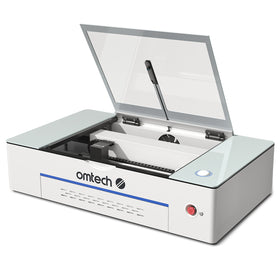
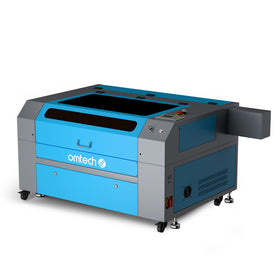
For someone starting a tumbler business, CO2 therefore offers a particularly attractive combination of speed, consistency, and ease of use. The OMTech Turbo-646 is a reasonable entry point at 60W, and stepping up to the autofocus OMTech Pronto-35S pays off quickly once you're running mixed tumbler sizes through the same machine every day.
2. Best for Bare Stainless-Steel Tumblers
If your goal is to engrave directly into stainless steel, a fiber laser is the better choice.
A fiber laser can produce permanent marks directly on the metal without relying on a coating or chemical marking compound.
For basic marking, a 20W fiber laser can be sufficient for many applications.
Higher-power machines provide additional production flexibility, particularly when deeper engraving is required.
If you want to explore color marking on stainless steel and titanium, a MOPA fiber laser provides additional control over the laser parameters.
This makes fiber technology the preferred choice for businesses where bare-metal drinkware is the primary product.
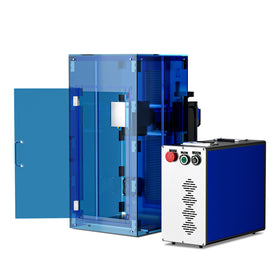
Within OMTech's range, that means starting at the 30W fiber tier and moving up to the MOPA models (M-30 through M-80) if color effects are part of your product line; worth browsing the MOPA & Fiber Laser Series directly, since availability shifts fairly often at each power tier.
3. Best for Glass Cups and Mugs
A CO2 laser is a proven option for engraving glass and can produce the familiar frosted effect used on wine glasses, beer mugs, mason jars, and other drinkware. However, because CO2 engraving relies on heat, excessive energy can produce microscopic fractures.
If you use the appropriate power and speed settings, you definitely can control the effect. Some common techniques such as applying a wet paper towel or dish soap to the glass help manage heat during engraving.
A UV laser is another option, particularly for premium glass engraving where a smoother finish and reduced thermal stress are priorities.
This can work for hobby applications, but it adds preparation and cleanup compared with using a CO2 or UV laser. For businesses working with glass regularly on a CO2 platform, the OMTech Polar 2 (70W, glass tube) is purpose-built around this use case.

Laser Engravers for Cups and Tumblers: Brief Overview
| Tumbler Type | Best Laser | Recommended Power | OMTech Options |
| Powder-Coated Tumblers | CO₂ laser | 40W–60W+ | Turbo-646 (60W) for entry-level production; Pronto-35S (60W) for greater flexibility with different tumbler sizes. |
| Bare Stainless-Steel Tumblers | Fiber laser | 20W+ | 30W Fiber as a starting point; MOPA M-30 through M-80 for color-marking capabilities. |
| Glass Cups & Mugs | CO₂ laser | Varies by application | OMTech Polar 2 (70W glass tube) for regular glass engraving on a CO₂ platform. |
Can One Laser Engrave Every Type of Cup and Tumbler?
Technically, there are ways to make a single laser system work across several materials, but there are compromises. A CO2 laser engraver is extremely versatile for powder-coated drinkware and glass, but it is not the ideal solution for direct bare-metal engraving.
A fiber laser excels at metal, but it is not the first choice for cutting acrylic or engraving every type of non-metal material.
- A diode laser can be affordable and versatile for hobby work, but its speed and wavelength limitations become increasingly noticeable in production.
- If you need to work across several materials, a versatile CO2 machine with an appropriate rotary can be an excellent starting point. If your business becomes heavily focused on bare-metal drinkware, adding a fiber laser later can expand your capabilities.
This is exactly the growth path OMTech's lineup supports: start with a CO2 machine like the Turbo or Pronto series and a rotary axis, then add a machine from the MOPA & Fiber Laser Series once bare-metal orders justify it. The important thing is to choose the machine around your primary material and production requirements, rather than trying to make one laser do everything.
Choosing a Laser Engraver For Cups and Tumblers? CO2 vs. Fiber vs. Diode
1. CO2 Lasers: Best for Powder-Coated Tumblers
If your primary goal is engraving powder-coated tumblers, a CO2 laser engraver is the best choice you can go for. CO2 lasers are particularly effective because their wavelength is strongly absorbed by the organic coating. When properly configured, the laser can remove the coating cleanly while leaving the stainless steel beneath largely unaffected.
- A 40W–60W or higher CO2 laser is a strong choice for businesses focusing on powder-coated cups and tumblers.
- A 60W CO2 laser, in particular, provides a useful balance between power and production speed. The result can be a clean, bright stainless-steel design against the colored coating.
Within OMTech's lineup, machines like the Turbo-646 (60W) sit right in this sweet spot, and it is LightBurn compatible out of the box. If you'd rather not deal with manual focusing between tumbler sizes, the autofocus Pronto-35S (60W) is worth the step up.

Can a CO2 Laser Engrave Bare Metal Cups?
A CO2 laser engraver cannot engrave metal cups directly in the same way as a fiber laser. A CO2 laser can be used with a specialized laser marking compound such as CerMark or similar products. You apply the compound to the metal before engraving, and it allows the laser to fuse the marking material to the surface.
This approach can work, but it is rather cumbersome: it introduces additional labor, materials, cleanup, and production steps. If bare-metal engraving is your primary business, investing in a fiber laser is generally the more straightforward solution.
2. Fiber Lasers: Best for Bare Metal Tumblers
If you want to engrave directly into uncoated stainless steel, aluminum, titanium, or brass, a fiber laser is the better choice.
A fiber laser operates at approximately 1,064 nm, a wavelength that interacts efficiently with metals. This makes it possible to produce permanent surface marks, deeper engravings, and high-contrast markings directly on bare metal.
You can use a 20W–50W fiber laser can be suitable for many drinkware applications, with higher-power machines providing greater flexibility for production speed and deeper engraving. For businesses specializing in bare-metal drinkware, a fiber laser is a much more appropriate investment than a low-cost CO2 or blue diode laser.
OMTech's MOPA & Fiber Laser Series covers this range from 20W up to 80W, so you can scale power to your production volume rather than overbuying on day one.

What About MOPA Fiber Lasers?
A MOPA fiber laser provides additional control over pulse characteristics, making it particularly useful when you want more control over the appearance of a metal engraving.
One of its major advantages is the ability to create color effects on materials such as stainless steel and titanium by adjusting the laser's pulse characteristics.
This makes MOPA fiber lasers attractive for more specialized drinkware customization where standard engraving is not enough.
3. Diode Lasers: Affordable, But Much Slower
Diode lasers can make sense for cups and tumblers if you are a hobbyist who wants to experiment with tumbler engraving without making a large investment.
Higher-powered diode machines can remove some types of coatings, especially darker coatings that absorb the diode's visible wavelength effectively. They can also be paired with rotary attachments for cylindrical objects.
The major drawback with a diode laser would be speed.
A tumbler engraving that takes seconds with a suitable CO2 galvo system can take many minutes with a diode laser. Depending on the machine, material, design, and settings, a complete wrap can take roughly 15 to 50 minutes.

That difference becomes significant if you are producing dozens of tumblers for customers.
Diode lasers also have difficulty with certain light-colored coatings. White and light-blue coatings can reflect much of the visible blue laser light rather than absorbing it effectively.
For occasional hobby work, this may not matter. For production, it can become a serious limitation.
If you want to experiment with both metal and non-metal drinkware materials on a single, lower-cost machine before committing to a dedicated fiber laser, OMTech's Solis Duo Series pairs a fiber and diode source in one unit, which can be a useful stepping stone.
4. UV Lasers: An Option for Glass
Glass requires a different approach. Because glass can absorb and distribute heat unevenly, excessive thermal energy can produce microscopic fractures or even cause the workpiece to crack.
A UV laser is particularly attractive for glass because its shorter wavelength allows what is often described as "cold processing." Instead of relying primarily on heat to produce the mark, UV energy interacts with the material at a much more localized level.
The result can be a clean, smooth, frosted engraving with less risk of micro-fracturing. A UV laser can therefore be an excellent choice for premium glass customization.
That said, CO2 lasers remain highly effective for glass and are often a more practical choice for businesses that also work with wood, acrylic, and other CO2-compatible materials. If glass is a regular part of your drinkware lineup, the OMTech Polar 2, which is built around a 70W glass CO2 tube, is worth a look for that reason.
CO2 vs. Fiber vs. Diode vs. UV for Cups and Tumblers
| Material | Best Laser | Alternative | Main Advantage |
| Powder-coated stainless steel | CO2 | Diode or Fiber | Quickly removes the coating while exposing the metal beneath |
| Bare stainless steel | Fiber | MOPA Fiber | Permanently marks or engraves the metal |
| Aluminum | Fiber | — | Direct metal marking and engraving |
| Titanium | Fiber/MOPA Fiber | — | Permanent marking and color effects |
| Brass | Fiber | — | Direct metal engraving |
| Glass | UV | CO2 | UV produces a clean, controlled frosted finish |
| Glass with a diode | Diode with coating/masking | — | Lower-cost but requires additional preparation |
The important takeaway is that there is no single laser that is perfect for every drinkware material. A machine optimized for powder-coated tumblers may not be the best option for bare metal, while a fiber laser that excels at stainless steel may not be the most versatile machine for glass and acrylic.

What Makes a Good Laser Engraver for Cups and Tumblers?
A good laser engraver for cups and tumblers needs to do more than produce a clean mark. It needs to handle the physical challenges of engraving a cylindrical object without allowing the workpiece to slip, rotate incorrectly, or move outside the laser's focal range. There are four things to consider before choosing a machine:
- Laser type and material compatibility
- Vertical or Z-axis clearance
- Rotary attachment type
- Software and rotary compatibility
Your desired production speed and whether you need the laser for other projects are also important.
1. Choose the Right Laser Source for the Cup/ Tumbler Material
The first question to answer is what type of cups and tumblers you intend to engrave. Powder-coated tumblers, bare stainless-steel cups, and glass do not interact with laser energy in the same way. Choosing the wrong type of laser would mean slow engraving, poor contrast, unnecessary chemical marking sprays, or even damage to the workpiece.
For most drinkware applications, the basic breakdown looks like this:
- CO2 lasers: Excellent for removing powder coatings and engraving glass.
- Fiber lasers: Best for permanently engraving bare metals such as stainless steel, aluminum, and titanium.
- Diode lasers: A lower-cost option if you are a hobbyist, but they are generally much slower and more limited.
- UV lasers: Excellent for glass cups and other types of material and applications where you need to minimize heat
The takeaway here is that the material the cup or tumbler is made of should therefore determine your laser choice: not simply the size or price of the machine. For most customers who shop with OMTech, this usually means picking between the CO2 laser range for coated tumblers and glass, and the MOPA & Fiber Laser Series for bare metal.
2. Ensure It Has Ample Vertical (Z-Axis) Clearance
A common beginner mistake is buying a compact laser that simply cannot physically fit a cup. To engrave a 40oz tumbler, the machine needs enough vertical space to accommodate the height of the rotary attachment mechanism, the thickness of the tumbler itself, and the focal distance required between the laser head and the cup.
Gantry-style CO2 machines with deep, motorized beds are popular specifically because they drop down low enough to clear large cups. Autofocus laser engraving machines like the OMTech Pronto Series make this easier day-to-day, since the machine automatically recalculates focal distance every time you swap in a bulkier tumbler or a slim glass; you're not manually resetting focus between jobs.
3. A Solid Chuck Rotary Over a Roller Rotary
The rotary mechanism largely dictates your success rate: For tumblers with handles or tapered shapes, you cannot do without a chuck rotary. Roller rotaries rely purely on gravity and friction to keep the cup in place.
| Rotary Type | How It Works | Best For | Risk |
| Chuck rotary | Clamps the cup securely from the inside or outside, like a lathe | Tumblers with handles or tapered shapes | Minimal — prevents slipping and walking off-center |
| Roller rotary | The cup simply rests on moving wheels | Perfectly straight bottles | Any top-heavy cup or handled tumbler can slip, ruining alignment |
Most OMTech CO2 machines are sold rotary-ready, and OMTech's own rotary axis attachments are worth checking against your tumbler shapes before you buy: matching the rotary to your most common cup style will save you more headaches than chasing an extra few watts of laser power.
4. Galvo vs. Gantry Mirror Speed
- Galvo (galvanometer) systems use high-speed moving mirrors to steer the laser beam from a fixed arm down onto the cup. For a drinkware business, a CO2 galvo or fiber galvo is widely recommended for its speed.
- Gantry systems move the entire laser head back and forth on a rail. They're slower for cup production but offer the versatility to cut large pieces of wood and acrylic when you're not making cups.
Buying Tip:
If speed on metal is the priority, it's worth keeping an eye on OMTech's galvo fiber marking machines when they're in stock, since a galvo head removes the travel time a gantry system spends physically moving across each tumbler.

5. It Must Be Compatible With LightBurn
A machine's software ecosystem is considered critical. It's worth prioritizing a laser that natively supports LightBurn, which features a dedicated "Rotary Setup" tool that handles the math behind a cup's circumference, preventing stretched or squished designs. Closed-ecosystem or cloud-only machines that restrict rotary flexibility are generally worth avoiding.
Every current OMTech CO2 and fiber machine, from the Turbo Series up through the Max Series, ships LightBurn compatible, so this isn't a box you need to double-check machine by machine.
Final Thoughts on Laser Engravers For Cups and Tumblers
The best laser engraver for cups and tumblers ultimately depends on what you are engraving and how much you plan to produce. But the laser source is only half the equation.
For cylindrical drinkware, the rotary attachment, Z-axis clearance, software compatibility, and overall workflow can have just as much impact on your results. A powerful laser is of little use if a 40 oz tumbler cannot fit inside the machine or if the rotary allows the cup to slip halfway through a full-wrap design.
For serious drinkware production, a stable chuck rotary and fast galvo system can dramatically improve throughput. For a business that also needs to cut wood and acrylic, a larger modular gantry laser may offer a better long-term investment.
Ultimately, the right machine is the one that matches the products you actually intend to make. Start with your material, determine your required production speed, check your tumbler sizes and rotary clearance, and then choose the laser technology that fits those requirements.
You may also be interested in the technicalities of choosing the best laser engraver for aluminum.