Top 8 Key Applications of Laser Engraving and Laser Cutting in the Defense/ Military Industry
If you own a laser engraving or cutting machine and want to move beyond hobby products or small consumer markets, the military and defense industry can be an immensely attractive direction.
Unlike consumer products that are usually driven by trends and seasons, the military industry rewards businesses that provide consistency more than novelty. If your laser system can repeatedly produce accurate, durable work, you become valuable.
Also, providing military-related engraving and laser cutting services can be a great way to stand out, expand your customer base, and delve into an area of business that will be rewarding, both financially and in terms of the fantastic people you will meet and work with.
So, what exactly does a laser engraving business do in the military industry? What are your options, and how can you best position yourself?
 4 Major Laser Engraving Applications in the Defense and Military Sector
1. Serial Number and UID Marking
One of the largest military laser engraving applications is permanent identification marking. This entails engraving serial numbers, QR codes, data metric codes, inventory labels, etc., onto rifles, vehicle parts, and equipment bags belonging to military units and members.
Some example projects in this category are:
- Rifle component serial numbers: engraving lower receivers, slides, or NFA Form 1 items (like short-barreled rifles and suppressors)
- Engraving vehicle part tracking labels
- Aircraft component identification
- Tactical communication equipment tags
- Ammunition storage labels
To understand what is needed for this application and how to market your services, it is important to know why serial numbers and UID marking matter to the military.
- Military equipment always needs to be marked with unique identification numbers, serial numbers, and tracking systems so that every component can be monitored throughout its lifespan.
- Many defense organizations also use UID (Unique Identification) systems to track parts from manufacturing through maintenance and eventual retirement.
Laser engraving is much preferred for such projects because it permanently marks these identifiers directly onto metal surfaces. With laser engraving, the marks are more likely to survive extreme heat, sand exposure, chemicals, abrasion, and long-term use.
 2. Weapon Component Customization and Marking
Laser engraving is frequently used in the military to mark caliber information, safety instructions, component labels, production codes, and manufacturer identification onto military weapons. Usually these include:
- Scope mount labels
- Trigger assemblies
- Magazine identification
- Rail systems
- Bolt carrier components
Military weapons contain numerous parts that usually require identification and safety information. So, rather than engraving entire assembled systems, the military requires the services of businesses to engrave individual components before assembly. In this application, consistency matters because poor markings can affect readability and compliance requirements. And, of course, you need to have a good mastery of gun engraving.
3. Aerospace and Aircraft Component Traceability
Military aircraft contain thousands of parts requiring inspection histories and maintenance tracking. Laser engraving in the aerospace sector focuses on engraving batch information, inspection dates, service codes, manufacturer IDs, and aircraft component references onto these components. Laser engraving allows these records to remain attached to the part itself.
Example projects
- Turbine parts
- Mounting brackets
- Hydraulic components
- Wiring panels
- Engine assemblies
Usually, there is a higher market barrier for this application, but the contracts are really long-term and reliable. This area is attractive if you run a high-end fabrication business, an aerospace subcontractor, or a precision engineering shop.
 4. Tactical Gear Personalization and Identification
Not all military laser engraving is industrial. Many military units and suppliers also engrave gear for identification and organization. This usually involves engraving names, unit identifiers, blood types, gear numbers, department information, etc., onto property or identification items belonging to individual military personnel.
Example projects
- Engraving dog tags
- Engraving tactical knives and flashlights
- Equipment cases
- Protective gear labels
These projects are easier to enter than the more industrial defense manufacturing applications, so they are more accessible if you are a smaller laser engraving startup, an Etsy-style business, a veteran business, or a custom tactical product brand.
Fiber lasers work well for metal items, and CO2 lasers may be needed for textiles, polymers, or coated materials.
Best Laser Engravers For Military Applications
Military applications use several different types of laser engravers because the materials involved vary widely: metals, polymers, optics, electronics, tools, weapons components, identification plates, aerospace parts, and tactical equipment all require different laser technologies. Generally, fiber laser engravers, MOPA fiber lasers, and CO2 lasers.
 1. Fiber Laser Engravers
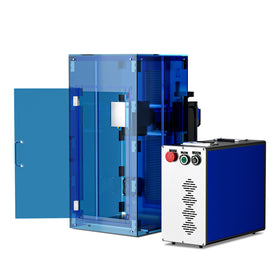
Fiber laser engraving machines, specifically Galvo fiber laser engraving machines, are among the most commonly used systems in military manufacturing and marking. That is because Galvo fiber laser engravers sufficiently comply with regulations, which require markings a certain number of inches in depth and height.
- In the U.S.A, these are known as ATF regulations, and the markings are required to be at least 0.003 inches deep and 1/16 inch high.
Also, fiber laser engravers are the logical choice because they are the most compatible with materials that the majority of military tools and equipment are made of. Usually, they are used for engraving steel, aluminum, titanium, brass, weapon components, dog tags, etc.
 Omtech Galvo fiber laser engravers, with an MTTF over 100,000 hours, offer greater speed and precision for etching precious metals while enabling a rainbow of colorful designs through adjustable pulse frequency and width. From stainless steel and gold to wood, leather, and more, these fiber lasers are best for very durable markings, extremely precise, fast production speed, and come with minimal maintenance.
2. MOPA Fiber Lasers
MOPA (Master Oscillator Power Amplifier) fiber lasers are an advanced form of fiber laser, and they are best used for sensitive metals, colored anodized aluminum, electronics, and fine detail work. The most common military uses are circuit board identification, electronic component marking, black marking on stainless steel, and color marking on titanium.
OMTech Solis Engraving Machines combine fiber and diode technology, giving makers the flexibility to personalize metal, wood, and more, all in a single machine built for creativity. With dual-laser flexibility in a single compact machine, you can switch between projects effortlessly and bring every creative idea to life with professional results.
 3. CO2 Laser Engravers For Military Applications
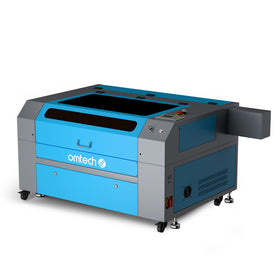
CO₂ laser engravers are typically used for non-metals like rubber, wood, fabric, leather, packaging, etc. In the military, they are used mainly for tactical gear labels, storage container markings, equipment cases, uniform patches, and training materials.
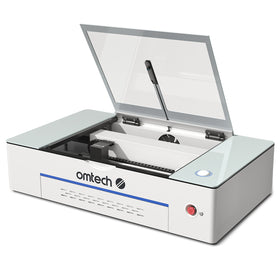
Omtech Pronto CO2 Laser engravers engrave at 1000mm/s – 37% faster than competitors, and an upgraded transmission system for superior accuracy in every detail. The Pronto’s maximum workpiece height is 8.7 inches, an impressive 83% increase that accommodates taller items.
They are excellent for organic materials, large work areas, and are more affordable than many of the metal engraving options.
Explore OMTech’s 5% Discount for Defense Contractors in the UK
Verified defense contractors and military suppliers qualify for an exclusive 5% discount on all industrial laser systems. Choose from our curated catalog of 100+ materials. From exotic wood veneers to specialty acrylics, save more when you stock up for large-scale projects.
Please fill out the form on this Military and Defense Industry page to submit and receive your discount.
Summary of Laser Engraving Applications in Military Applications
When going into laser engraving projects in the defense/military sector, the objective should not be "selling military products." Instead, your goal should be to become a reliable manufacturing or production partner that solves practical problems. Businesses entering military applications should focus on:
- Permanent identification and traceability
- High-precision component manufacturing
- Durable markings that survive harsh environments
- Repeatable production standards
- Specialized fabrication for military equipment suppliers
 4 Laser Cutting Applications in the Defense and Military Sector
Laser cutting plays a dual role in the military: industrial manufacturing of defense equipment and tactical field applications via directed-energy weapons. In production, it provides the strict precision required to meet MIL-SPEC standards while minimizing material waste.
So, while engraving focuses on identification, laser cutting focuses on fabrication. Laser cutters help produce actual components used in military systems.
1. Defense Manufacturing Applications
- Armor plating: Heavy-duty CNC fiber lasers cut ultra-hard, high-stress steel and titanium alloys for vehicles like Humvees and tactical trucks.
- Aerospace components: Non-contact cutting prevents warping and thermal distortion when fabricating delicate fuselage frames, wing flaps, and engine parts.
- Tactical textiles: Modern gear production utilizes CO2 lasers to slice high-strength Cordura nylon, forming integrated, low-profile laser-cut MOLLE slots on body armor carriers to reduce vest weight.
- Logistics and traceability: High-speed marking lasers etch permanent, MIL-STD-130-compliant UID barcodes and serial numbers directly onto weaponry, ammunition, and tools.
2. Drone and UAV Component Production
Many military drone structures contain lightweight parts that are cut with laser systems. Laser cutting is much preferred for this because it creates precise components while minimizing material waste. Some example projects are internal frame components, sensor mounts, battery compartments, and carbon fiber panels.
This application can be especially attractive to a prototype business, an aerospace startup, or a precision fabrication shop. A smaller laser engraver company can even enter UAV manufacturing supply chains more easily than traditional military industries.

3. Gasket and Seal Manufacturing
Military equipment uses large numbers of seals and protective components. Laser cutters can produce them efficiently. This is a great military-grade laser-cutting application for a small manufacturing company, a packaging business, or a prototype shop. Entry costs can be lower than in heavy industrial fabrication, so it is a feasible option.
Example projects
- Rubber seals
- Foam inserts
- Protective padding
- Equipment compartment gaskets
4. Rapid Prototype Development
Defense projects constantly require testing and redesign. Laser cutters help engineers produce prototype parts quickly. Fiber or CO2 laser cutting systems are perfect for this use, depending on the material type. This is ideal if you are an engineering workshop, an R&D facility, or a startup serving a defense contractor. Rapid iteration can create recurring work.
Example projects
- New mounting systems
- Equipment enclosures
- Testing fixtures
- Mechanical concepts
Laser Engraving vs. Laser Cutting in Military Applications
| Laser Engraving | Laser Cutting |
| Creates markings | Creates components |
| Focuses on identification | Focuses on manufacturing |
| Usually lower material consumption | Higher material use |
| Often performed after manufacturing | Often performed early in production |
| Common for tracking and compliance | Common for fabrication |
Many people think laser engraving and laser cutting are simply two settings on the same machine. For military applications, that mindset can become expensive.
- Laser engraving modifies a surface.
- Laser cutting creates or shapes a part.
That distinction matters because military clients often have very different needs.
For a business owner, understanding this difference changes your strategy. If your strength is detailed, precision-oriented marking, targeting identification, and compliance work makes sense. If you already operate sheet metal or fabrication equipment, component production may be a more logical route. Some businesses eventually combine both services.
For example:
- A laser cutter creates drone frame parts.
- A laser engraver then adds serial numbers and identification markings.
Providing both can make a company more attractive because customers prefer fewer suppliers.
 Which Military Laser Applications Fit Different Entrepreneurs?
Not every military laser opportunity makes sense for every business owner. The ideal path depends heavily on budget, experience, equipment, and business goals.
1. For new laser engraving businesses
If you are a new laser engraving business, focus on making and selling military gifts, such as tactical gear identification and customization. This includes dog tags, equipment labels, personalized gear, and organizational markings that require lower investment and have smaller barriers to entry. You can begin with a relatively small fiber laser while building experience.
2. For existing metal fabrication companies
Vehicle components and military structural parts can be a strong fit for an existing metal fabrication company. Because these businesses already possess welding capability, material-handling experience, and metalworking expertise, adding laser technology naturally expands their services.
3. For precision engineering shops
Aerospace traceability and component marking can be attractive. These applications require strict tolerances and quality systems but often involve high-value work.
 Final Thoughts on Laser Engraving/Cutting in the Military
Military laser applications are less about producing flashy products and more about solving practical operational problems. Laser engraving keeps equipment identifiable and traceable, and laser cutting helps create the physical systems and structures that military operations rely on.
For businesses entering this market, the biggest opportunity often comes from positioning yourself as a dependable manufacturing partner rather than simply a laser operator. In military work, precision is expected, repeatability builds trust, and reliability often matters more than creativity.