How Laser Engraving Is Used in Medical Device Traceability
I once saw a consultant pause during a procedure to check the serial number on an orthopaedic plate. The instrument had already been through multiple sterilisation cycles that week. Under the theatre lights, he tilted it slightly and read the Data Matrix code without hesitation. The mark was as crisp as the day it was applied. That’s the real requirement in medical marking — not how it looks in a brochure, but whether it’s still readable in a sterile field years later.

Across the UK, any medical device that comes into contact with a patient — whether reusable, single-use, or implantable — must carry a permanent, machine-readable identifier. Labels can peel, inks fade, and adhesives risk contamination. Laser marking remains the only method that consistently survives the full lifecycle of a device: manufacturing, sterilisation, clinical use, and in some cases, decades inside the human body.
This guide explains how laser marking is used in UK medical device manufacturing — including regulatory requirements under UK MDR, the appropriate laser processes for different materials, and the systems capable of delivering compliant, biocompatible marks. OMTech’s fibre and MOPA laser systems are widely used by contract manufacturers and device suppliers to mark stainless steel, titanium, and medical-grade alloys with precision and permanence.
Why Laser Marking Is Essential for UK Medical Device Compliance
In the UK, medical device traceability is governed by the UK Medical Device Regulations (UK MDR 2002, as amended), alongside global frameworks such as UDI (Unique Device Identification) aligned with international standards.
UDI requires that devices carry:
- A Device Identifier (DI) — model/version reference
- A Production Identifier (PI) — batch, serial number, manufacture date, etc.

For reusable devices — such as surgical tools or implants — this information must be marked directly on the device itself, not just on packaging.
Traditional marking methods fail under real conditions:
- Adhesive labels degrade in autoclaves
- Ink markings fade after repeated sterilisation
- Surface coatings may delaminate over time
Laser marking solves this by creating permanent, high-contrast marks that withstand:
- Steam sterilisation (autoclave)
- Ethylene oxide (EtO) sterilisation
- Gamma radiation
- Mechanical wear and handling

REAL UK MANUFACTURING CONTEXT
A UK-based contract manufacturer producing stainless steel surgical instruments switched from ink-based marking to laser annealing after repeated audit findings related to mark durability. After implementing a MOPA fibre laser system and validating the process to ISO 13485 standards, their marking compliance issues were fully resolved, and audit outcomes improved significantly.
The Four Laser Marking Processes Used in Medical Devices
Medical laser marking isn’t one-size-fits-all. The process must match the material, application, and regulatory requirements.
Laser Annealing (Preferred for Surgical Instruments)
- Process: Subsurface oxidation (no material removal)
- Result: Dark, high-contrast mark
- Best for: Stainless steel, titanium
- Key benefit: Preserves corrosion resistance and surface integrity

This is the gold standard for reusable surgical instruments in the UK. It avoids surface damage and prevents bacteria-trapping microstructures.
Laser Ablation
- Process: Removes coating or surface layer
- Result: High-contrast mark exposing substrate
- Best for: Anodised aluminium, polymers, coated components
Common for catheter markings, polymer devices, and coated metal parts.
Laser Etching
- Process: Slight մակ surface melting
- Result: Shallow textured mark
- Best for: Non-critical components
Faster but not ideal for implant surfaces or fluid-contact areas.
Laser Engraving
- Process: Deep material removal
- Result: Highly durable, tactile mark
- Best for: Orthopaedic implants, high-wear tools
Use with caution — deep grooves can trap contaminants if used on sensitive surfaces.
Process Comparison
| Process | Material Removal | Typical Use | Surface Impact | Biocompatible |
|---|---|---|---|---|
| Annealing | None | Surgical tools, implants | Colour change only | Yes |
| Ablation | Surface layer | Polymers, coatings | Coating removed | Yes |
| Etching | Minimal | Housings, components | Slight texture | Case-by-case |
| Engraving | Deep | Implants, heavy-use tools | Recessed surface | Depends |
Choosing the Right Laser for Medical Applications
Fibre Laser — Industry Standard for Metals
Fibre lasers (1064nm) are the default choice for:
- Stainless steel
- Titanium
- Aluminium alloys
They deliver fast, precise marking suitable for serial numbers, barcodes, and UDI codes.
MOPA Fibre Laser — Critical for Medical-Grade Stainless Steel
MOPA systems provide pulse duration control, enabling true annealing without damaging the protective oxide layer.
This is essential for:
- ISO 13485 compliance
- Corrosion resistance
- Long-term durability
For UK manufacturers working with surgical-grade stainless steel, MOPA is often the required solution.
UV Laser — For Plastics and Sensitive Materials
UV lasers (355nm) use a “cold marking” process:
- Minimal heat impact
- Ideal for polymers like PEEK and polycarbonate
- No structural damage
Laser Type Summary
| Laser Type | Best Materials | Process | Passivation Safe |
|---|---|---|---|
| Fibre | Metals | Etching, ablation | Yes (if optimised) |
| MOPA Fibre | Stainless steel, titanium | Annealing | Yes |
| UV | Plastics, polymers | Photochemical marking | N/A |
| CO2 | Packaging, non-metals | Surface marking | Limited for devices |
What UDI Compliance Requires in Practice
UDI marking must include both machine-readable and human-readable elements:
- Data Matrix code (2D) — standard for small devices
- Linear barcodes — used for larger items
- Serial numbers — readable without scanning
- Batch/lot numbers — for traceability
Marks must remain readable after:
- Repeated sterilisation cycles
- Mechanical handling
- Long-term use
Important Compliance Note
In the UK, the manufacturer — not the laser supplier — is responsible for validation.
This means:
- Laser parameters must be tested and documented
- Durability must be proven under real conditions
- Any change in process requires revalidation
OMTech Systems for Medical Device Marking
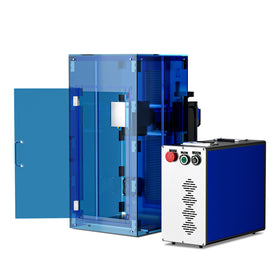
Medical manufacturers in the UK commonly use OMTech’s fibre and MOPA systems for precision marking:
Galvo Fibre 20–50W — High-Speed Production Marking
- Serial numbers, barcodes, UDI codes
- High-speed galvo scanning (up to 10,000 mm/s)
- Suitable for stainless steel and titanium
MOPA 60W Fibre — Medical-Grade Annealing
- True annealing without passivation damage
- High-contrast marks for surgical instruments
- Designed for compliance-critical environments
100W MOPA Fibre — Implants & High Precision
- Ideal for orthopaedic implants and small components
- Handles fine text (down to ~1.5 mm)
- Consistent results on titanium alloys
Setup and Validation Support
While manufacturers must validate their own processes, proper installation and parameter setup are critical starting points. A well-configured system reduces validation time and ensures consistent results.
Final Thoughts
Laser marking in medical manufacturing isn’t about aesthetics — it’s about traceability, safety, and compliance. In the UK’s regulated environment, where devices must remain identifiable throughout their lifecycle, laser marking has become the standard not because it’s convenient, but because it works when everything else fails.
Frequently Asked Questions
What is laser marking for medical devices?
It’s the process of permanently marking devices with identification data using a laser, without inks or chemicals. The result is durable, sterilisation-resistant, and compliant with UK MDR and ISO standards.
Why is laser marking required?
UDI regulations require permanent traceability. Other marking methods cannot survive sterilisation or long-term use.
What’s the best laser for stainless steel instruments?
A MOPA fibre laser — it enables annealing without damaging corrosion resistance.
Can laser marking affect biocompatibility?
If done correctly (e.g., annealing), it preserves surface integrity and remains biocompatible.
Do marks survive sterilisation?
Yes — properly applied laser marks withstand autoclaving, EtO, and radiation sterilisation.