How To Start a Laser Cutting Business in the UK
Your goal, when starting a laser cutting business, should be to build a repeatable and profitable production business that uses laser cutting to turn materials into products customers are willing to pay for, while keeping production costs low enough to scale.
The good news is, many key principles have been identified by successful laser cutting entrepreneurs, which can act as a guideline to follow, and these usually center around identifying a profitable niche, choosing the right laser machine for your material, minimizing production costs, and pricing your products for healthy profit margins.
You can think of these as the foundational pillars of building and running a successful laser cutting business in the UK: find a unique product or underserved niche before buying a machine, choose equipment around your actual production requirements, and treat your laser as a business tool, not a money printer.

1. Find Your Laser Cutting Niche First
The key to succeeding in the laser cutting business world in 2026 is to avoid niches or products that are already saturated. Generic items like basic engraved cutting boards or standard signs face intense online competition.
Instead, focus on opportunities where your laser can solve a specific problem or create something difficult to replicate. For example:
- Solve specific problems: Focus on custom local jobs, replacement brackets, unique home décor, architectural models, personalised products, or B2B branding rather than competing solely on generic products in crowded online marketplaces.
- Combine your skills for more creative projects: Laser cutting becomes even more valuable when combined with woodworking, leathercraft, signage, furniture making, or event planning. Combining different skills can help you create products that are more difficult for competitors to copy.
- Look for local demand: UK businesses, wedding suppliers, pubs, restaurants, retailers, tradespeople, schools, and event organisers can all provide potential customers for customised laser-cut products and services.
The goal here is not necessarily to find a completely new product. It is to find a specific customer with a specific problem that you can solve profitably.
2. Define Your Business Model
Before investing in a laser cutter, decide how you intend to make money from it. Most laser businesses fall broadly into two categories: product-based businesses and service/job-shop businesses.
- Product-based model: You design and manufacture unique, repeatable items (e.g., custom cabinet parts, complex 3D wood assemblies, or unique merchandise). The advantage with a product-based laser cutting business model is that margins are higher because you're selling the design, but it demands more creativity up front.
- Service/job-shop model: You offer custom etching or manufacturing for third parties. Success here depends almost entirely on volume. Veterans heavily recommend prioritizing business-to-business (B2B) clients over individual retail customers; landing local corporate clients for bulk promotional materials yields repeatable revenue with far less client-management friction than one-off retail orders.
You can also combine the two. For example, you might sell your own range of personalised products online while accepting cutting and engraving jobs from local businesses.

3. Choose the Laser Machine You Need, Not the Machine You Want
Buying a laser machine for a business is a significant investment, so your equipment should be selected according to the materials, product sizes, production volume, and applications you actually plan to handle.
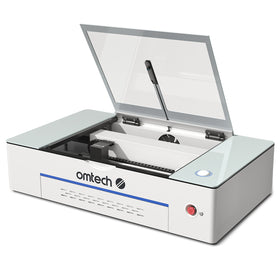
For a small to medium-sized laser cutting business in the UK, your main options are a high-power diode laser, a 60W+ CO₂ laser, or a fibre laser cutting machine, depending on the materials you work with.
- Diode lasers (20W–40W): A relatively affordable starting point for applications such as light engraving and thin-wood cutting. However, they generally offer less cutting capability and throughput than higher-powered CO₂ systems.
- CO2 lasers (60W+): A 60W CO2 laser engraver is generally considered to be the industrial baseline for laser cutting businesses by most laser business veterans. A CO2 laser is essentially mandatory if you plan to cleanly cut thick acrylic, organic wood, and plastics.
- Fiber lasers: Fiber laser cutting machines are very highly specialized, and really only necessary if your business centers on deep engraving or cutting/marking metal.
Important Notes On Buying a Laser Machine for a Laser Cutting Business
- A low-cost diode laser can be suitable for light engraving and smaller projects, but a CO₂ laser is generally a better choice if your business depends on faster and cleaner cutting of wood, acrylic, and similar materials.
- Power also matters. Moving from a lower-powered machine to a 55W, 80W, 90W, or 100W+ CO₂ laser can significantly increase cutting capability and reduce the amount of time spent producing each item.
- Also, before committing to a machine, consider visiting a local makerspace, fabrication workshop, or laser-focused community where possible. This will allow you to learn design software, understand laser workflows, and test your ideas before committing several thousand pounds to equipment. You can visit the nearest OMTech UK showroom and book a free demo (no obligation to buy), no matter where you live in the UK.
4. Establish a Legal and Safe Workspace
Whether you operate from a dedicated workshop, commercial premises, or your home, you need to consider the safety, insurance, ventilation, and legal requirements associated with running a laser business.
Obtain local permission: If you plan to operate from home in the UK, check whether you need permission from your landlord or mortgage provider, whether your local planning authority needs to be consulted, and whether your business could affect your council tax or business rates. GOV.UK notes that running a business from home can require permission or separate insurance depending on the circumstances.
Deal With Fume Mitigation
Laser cutting and engraving can produce smoke, particulates, and potentially hazardous fumes depending on the material being processed. Your workshop therefore needs an appropriate method of controlling and removing these emissions.
For many installations, this means connecting the laser's exhaust system to a suitable external ventilation system. Where external extraction is not practical or permitted, a properly specified filtration system may be necessary.
Do not assume that a standard household air purifier is sufficient for laser cutting. Your ventilation or local exhaust ventilation (LEV) system should be designed around the machine, materials, workspace, and applicable UK health and safety requirements.
For commercial workplaces, employers have duties relating to exposure to substances hazardous to health under the Control of Substances Hazardous to Health (COSHH) regulations. Appropriate extraction systems may also need regular examination and testing depending on the installation and circumstances.
Business Insurance
Don't assume that your household insurance automatically covers a laser business operated from your home. GOV.UK specifically advises that home insurance may not cover business activities, stock, equipment, or customers visiting your premises.
Consider appropriate business insurance and public liability insurance, and speak with an insurer about the specific risks associated with laser equipment. If you employ anyone, employers' liability insurance is generally a legal requirement in the UK.
Sole Trader or Limited Company?
You also need to decide how your business will be structured.
- A sole trader structure is relatively straightforward and is commonly used by people starting small businesses. However, sole traders have unlimited liability, meaning you can be personally responsible for the business's debts.
- Alternatively, you can establish a private limited company (Ltd). A limited company is a separate legal entity and can provide limited liability protection, although it also comes with additional administrative and reporting responsibilities.
The right structure depends on your circumstances, so consider speaking with an accountant or qualified business adviser before making the decision.

What Is The Best Fume Mitigation Solution For a Fiber Laser Cutting Business?
If you have permission to drill through a wall or exhaust via the roof, direct exterior venting is the most affordable, low-maintenance, and highly effective option.
Take note that where you place the fan is very important. Place the exhaust fan at the very end of the line (at the wall penetration point or outside), not right next to the laser. This creates negative pressure (a vacuum) throughout the entire length of the ducting. If the fan is next to the laser, it creates positive pressure, forcing toxic smoke out of any microscopic pinholes in your ductwork and right into your shop.
- Duct Size: Upgrade to a 6-inch (150mm) rigid duct rather than a 4-inch flexible hose. Flexible hoses have ridges that create extreme airflow resistance (static backpressure).
- Fan Choice: Use a high-CFM centrifugal blower or a heavy-duty mixed-flow inline fan (like the AC Infinity Cloudline series). It must move a minimum of 150–400 CFM depending on machine size.
- The Chimney Stack: If you have neighbors or are in a commercial strip, build a PVC or metal "stack" to vent the fumes above the roof line/guttering so the smoke can rapidly disperse without entering nearby windows.
Do not assume that a standard household air purifier is sufficient for laser cutting. Your ventilation or local exhaust ventilation (LEV) system should be designed around the machine, materials, workspace, and applicable UK health and safety requirements.
5. Handle Logistics and Pricing
- Protect yourself: Business liability insurance is essential, since home insurance won't cover fire or damage caused by a commercial laser setup.
- Prioritize local marketing: Spend time building local sales channels, farmers' markets, and partnerships with nearby retail shops, which often yield better early results than crowded online marketplaces.
- Calculate true costs: A common beginner pitfall is underpricing labor. Rather than simply doubling your material cost, use a multi-variable formula that adds material costs, hourly labor rates for design and production, monthly overhead (ventilation, power), and equipment wear and tear.
This is particularly important in the UK, where your advertised retail price may also need to account for VAT once your business becomes VAT registered.

Understand UK VAT
As of 2026, UK businesses generally need to register for VAT when their taxable turnover exceeds £90,000 in a rolling 12-month period, although voluntary registration is possible below that level.
Don't wait until you reach the threshold to think about VAT. If you expect your business to grow quickly, understanding how VAT will affect your pricing, cash flow, and margins from the beginning can help you avoid unpleasant surprises later.
You should also keep accurate business records and understand which expenses can be claimed. HMRC allows certain business costs, including relevant premises, utilities, insurance, and equipment costs, to be treated as allowable expenses or capital allowances depending on your accounting method and circumstances.
6. Validate Globally, Sell Locally
Etsy and other online marketplaces are fiercely competitive, and margins tend to spiral downward against massive, automated print-on-demand operations.
- Design originality: Create custom vector art using professional vector design software rather than replicating trending templates. AI tools can also be a useful starting point for generating laser-engraving files.
- Local channels: Early on, prioritize venues where customers can physically inspect the tactile quality of your products, local craft fairs, high-end farmers markets, boutique partnerships, or wholesale direct-to-business networks.
OMTech Pronto CO₂ Lasers for Your Laser Cutting Business
For a laser cutting business, 60W to 150W CO₂ lasers offer an excellent balance of cutting capability, productivity, and operating cost. While lower-powered machines can handle thinner materials, a 40W laser may take longer to cut materials in the 3–6 mm range, which can limit productivity and reduce your potential profit per working hour.
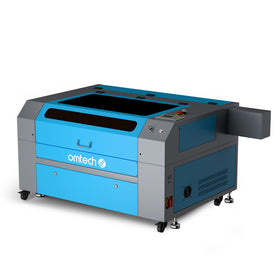
OMTech’s Pronto Series CO2 Laser Engravers ( 60W to 150W ) are designed with small businesses and production-focused users in mind. These CO₂ laser cutters combine high engraving speeds, upgraded transmission systems, generous working areas, and features designed to help you produce more while maintaining consistent results.
- With engraving speeds of up to 1,000 mm/s, Pronto machines are built to help you move through production jobs efficiently. Their upgraded transmission system also supports accurate movement and consistent results across detailed designs.
- Another advantage is the machines’ 8.7-inch maximum workpiece height, giving you more room to work with taller objects. This represents an 83% increase in workpiece height compared with previous designs, making the Pronto series more versatile for businesses working with a wider range of products.

OMTech Pronto 40 90W CO₂ Laser Cutter and Engraver
The OMTech Pronto 40 90W CO₂ Laser Cutter and Engraver is a strong option for businesses looking for a production-capable machine without moving immediately into a much larger industrial system.
It features a 24" × 35" working area, autofocus, and a maximum engraving speed of 1,000 mm/s. With 90W of CO₂ laser power, it can handle a broad range of cutting and engraving applications, making it suitable for businesses producing signage, personalized products, displays, décor, and other custom items.
Why Choose OMTech Pronto Lasers for Your Laser Cutting Business?
Ruida Controller Compatibility
Pronto machines use Ruida digital controllers and are compatible with LightBurn, giving operators access to a familiar workflow for creating, preparing, and controlling laser jobs.
Fully Enclosed Cabinet
For businesses operating indoors, the fully enclosed cabinet helps contain smoke and fumes generated during laser processing. When properly connected to an appropriate exhaust system, the enclosure and extraction setup can help remove potentially harmful fumes from materials such as acrylic and leather from the workspace.
UK businesses should still assess their individual ventilation requirements and comply with applicable workplace health and safety requirements rather than relying on the enclosure alone.
Front and Back Pass-Through Doors
Each Pronto machine features front and rear pass-through doors, allowing you to work with materials that are longer than the standard bed length.
This can be particularly useful for cutting oversized plywood, acrylic sheets, and other long workpieces without requiring an oversized, room-filling laser bed.
For UK workshops where floor space can be limited, this can be a particularly useful feature when you're trying to increase production capacity without immediately moving into much larger premises.
Together, these features make the OMTech Pronto series a practical choice for entrepreneurs who want to turn laser cutting and engraving into a productive business while keeping their equipment footprint manageable.

How to Choose a Fiber Laser Laser Cutter For Business
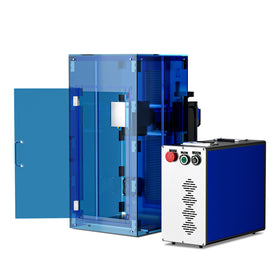
If metal laser cutting is part of your business plan, there are two main paths when it comes to fiber lasers: a high-power galvo laser engraver, or a flatbed fiber laser cutting machine. Which one you need depends on the size and scale of your business, the thickness of the metal you intend to cut, and your budget.
1. High Power MOPA Fiber Lasers: Best For Metal engraving, marking, and light jewelry Cutting
If your business focuses on metal engraving and marking, with light jewelry or thin-metal cutting on the side, a high-power desktop MOPA fiber laser (like a 60W to 100W JPT MOPA unit) is generally the right starting point.
A 60W JPT MOPA fiber laser, like the OMTech MOPA 60W Split Fiber Laser Engraver, is primarily built for marking and engraving rather than cutting. That said, OMTech notes that with multiple high-frequency overlapping passes, a 60W or 100W MOPA unit can cleanly cut thin precious-metal blanks (gold, silver, or brass jewelry pieces) up to about 1mm thick.
That's enough for light jewelry and token cutting, but it's not a substitute for a dedicated cutting machine if metal cutting is your primary business.
100W MOPA Split Fiber Lasers: Best For Heavier Metal Engraving and Cutting Projects:
For more demanding work, the OMTech MOPA 80W Split Fiber Laser Engraving Machine steps up to 100W output with two selectable workspaces, making it capable of handling a wider range of projects efficiently. Like the 60W model, it's still a marking/engraving-first machine, with the same thin-metal cutting capability via overlapping passes.
Flatbed Fiber Laser Cutters: Best For Structural Sheet Metal Cutting
If your business plan requires cutting structural sheet metal ( full 4x8 sheets of steel, for example ), you need to step up to a dedicated, heavy-duty 1,000W+ flatbed fiber laser cutter. The OMTech FC-22 1500W Fiber Laser Cutting Machine is a fully enclosed, entry-level option with front and back pass-through and a built-in water chiller. It reaches a 27.56 in/s cutting speed and can cut through up to 0.2 in. stainless steel and up to 0.4 in. carbon steel.
Fiber Laser Types for a Laser Cutting Business, Summarized
| Business Need | Recommended Laser | Recommended Machine | Best For |
|---|---|---|---|
| Engraving & light jewelry/token cutting | 60W–100W JPT MOPA fiber laser | OMTech MOPA 60W Split Fiber Laser Engraver | Small businesses focused on metal engraving, marking, jewelry, and small tokens |
| Heavier metal engraving & light cutting | 80W JPT MOPA fiber laser | OMTech MOPA 100W Split Fiber Laser Engraving Machine | Businesses handling more demanding metal engraving and light cutting projects |
| Structural sheet metal cutting | 1,000W+ flatbed fiber laser | OMTech FC-22 1500W Fiber Laser Cutting Machine | Businesses cutting thick, large steel sheets, including production work |
Final Thoughts on Starting a Laser Cutting Businesses
The businesses that make it past year one in laser cutting tend to share a pattern: they picked a specific, underserved problem to solve before they picked a machine, and they matched their equipment to that problem rather than the other way around.
A diode laser won't get you far in a metal-fabrication niche, and a 6kW fiber cutter is an expensive answer to a jewelry-engraving question. Get the niche, the business model, and the legal groundwork sorted first; the machine decision gets much easier once those are settled.
If metal work is on your roadmap, start with an honest read of what you're actually doing: marking and light engraving points you toward a MOPA desktop unit, while real sheet-metal cutting means budgeting for a dedicated flatbed cutter like the FC-22 from day one. T
Trying to stretch a marking machine into a cutting role, or vice versa, is one of the more common and avoidable ways new laser businesses waste their starting capital.
You may also be interested in wood laser cutting ideas you can begin with as you launch your business.