Why More Fabrication Shops Are Moving to Industrial Laser Cutting
Walk through any mid-sized British engineering or fabrication shop today, and there is a very high chance you will see a fibre laser hard at work. It might be high-speed marking serial numbers onto machined components or slicing through precision sheet metal—sometimes both, split across two dedicated machines running all day long.
Go back a decade, and this setup was a luxury reserved for tier-one manufacturers. Today, it is rapidly becoming the standard on UK workshop floors.
Traditional machinery like plasma cutters, waterjets, and mechanical shears still have their place. However, industrial laser cutting has steadily claimed more floor space and taken over jobs that used to require massive setup times, secondary finishing, or expensive consumable tooling. The shift isn't because lasers look high-tech; it is simply because the unit economics make sense.

What Changed? The Accessibility Shift
Historically, industrial laser cutting machines required a massive, six-figure capital expenditure. That structural cost kept smaller UK fabrication shops locked into plasma or waterjet setups for years, even when operators knew a laser would deliver a superior finish.
Two major factors have completely flipped the script:
-
The Price Barrier Collapsed: Entry-level industrial fibre laser cutters have reached a price point that an independent workshop with steady contract volume can comfortably justify. The payback period has shrunk dramatically.
-
The Learning Curve Flattened: Early generation fibre cutters demanded highly experienced laser technicians to manually tune the beam alignment and cutting gases. Modern systems featuring autofocus heads and intuitive CNC software handle the heavy lifting dynamically. A machinist who has never touched a laser before can confidently run production batches in days, not months.

Processing Metal: Where Fibre Lasers Dominate
While heavy oxy-fuel or plasma setups still win on rough demolition work or massive steel plates over 25mm thick, fibre lasers are practically unbeatable for sheet metal under 12mm.
Fibre lasers easily process mild steel, stainless steel, aluminium, brass, and copper. The laser's kerf (the width of the cut) is incredibly narrow, meaning your nested parts can sit tighter together, significantly reducing material scrap.
Because the edges emerge incredibly smooth, components destined for architectural metalwork, electrical enclosures, or HVAC ducting can completely skip the tedious manual deburring stage.
The Industrial Hardware Lineup
To meet different workshop layouts and ventilation requirements, industrial platforms generally fall into two configurations:
-
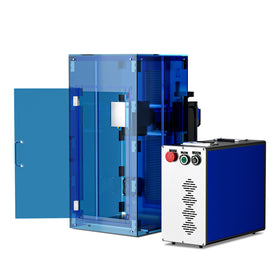
The Fully Enclosed Solution: Platforms like the OMTech 1500W Fully Enclosed Fibre Laser Cutting Machine are engineered for high-throughput workspaces. The sealed safety cabinet safely contains reflections and fumes, features an integrated water chiller to handle heavy cycles, and uses a practical pass-through design for processing long flat stock.
-
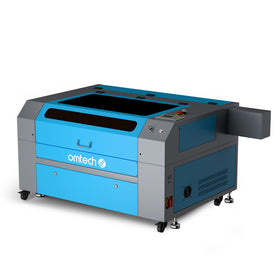
The Open-Frame Alternative: If your daily workflow involves loading large, irregular, or over-sized workpieces, the OMTech 1500W Open Metal Laser Cutter Machine delivers identical optical processing power with maximum physical access to the cutting bed from all sides.
The Ultimate Argument: Edge Quality vs. Secondary Labour
The debate between sticking with an existing high-definition plasma cutter or upgrading to an industrial fibre laser usually lands on a single metric: edge quality.
Plasma systems leave behind a rougher, highly oxidized edge profile with a noticeable amount of hard slag or "dross" on the bottom of the workpiece. Slicing a component this way means paying a fabricator to manually grind or linish those edges before the part can be welded, powder-coated, or shipped to a client. That represents a massive leak in your workshop's labour margins.
According to metallurgical standards, the precise focus of a fibre laser creates a highly concentrated heat-affected zone (HAZ). This minimal thermal transfer prevents thin sheet metal from warping, keeps your dimensional tolerances dead-on, and ensures dross is virtually nonexistent on properly calibrated cuts. The part comes off the slats ready to drop straight into a finished assembly.
Fibre Laser Specs That Actually Matter
When evaluating an industrial fibre cutter for a UK small business or contract workshop, it is easy to get bogged down in technical noise. Focus on these core criteria to protect your investment:
1. Optical Power Output
For standard sheet metal fabrication under 10mm, a 1000W to 1500W fibre source is the industrial sweet spot. Extra wattage doesn't automatically mean better quality on thin gauge metals; it simply increases your maximum cutting travel speed and allows you to push through thicker plate when required.
2. Integrated Water Cooling
Fibre laser sources generate significant internal heat during prolonged production runs. Running a high-kilowatt machine without robust cooling will drastically shorten the lifespan of your optics. Always ensure your machine includes a high-capacity, integrated refrigerated water chiller.
3. Native CAD/DXF Compatibility
Your shop floor shouldn't have to fight with complex file conversions. Ensure the machine's control interface imports standard DXF format files directly from your existing CAD software workflow, allowing you to go from a customer's drawing to an active cut path in minutes.
Where Architectural Metalwork and Fibre Intersect
Beyond pure structural engineering, fibre cutting has become a core asset for high-end interior design and architectural fabrication firms across the UK.
While a classic CO₂ laser is perfect for cutting the timber or acrylic elements of an architectural scale model, a fibre cutter opens up the manufacturing of bespoke perforated cladding panels, intricate metal privacy screens, radiator grilles, and custom ironmongery. The absolute repeatability of a fibre gantry ensures that panel number one looks identical to panel number one hundred, eliminating any hand-crafted inconsistencies.
Frequently Asked Questions
What maximum thicknesses can a 1500W fibre laser cut?
A 1500W fibre laser can comfortably cut mild steel up to roughly 10mm to 12mm, and stainless steel or aluminium up to approximately 5mm, depending entirely on your selection of assist gas and machine calibration.
Why do I need assist gases for cutting metal?
An assist gas is mechanically injected through the laser nozzle to blow away molten metal from the kerf. Oxygen is typically used for mild steel because it creates an exothermic reaction that speeds up the cut. Nitrogen is used for stainless steel and aluminium because it shields the cut zone from oxygen, preventing edge discolouration and leaving a clean, weld-ready surface.
Is an enclosed fibre laser cutter better than an open-bed system?
An enclosed machine offers the highest level of workshop safety by completely shielding staff from Class 4 laser reflections and simplifies atmospheric fume extraction. An open-bed system, however, is often highly practical if you have limited headroom or frequently need to crane-load heavy, non-standard sheets of metal directly onto the bed.
How long do industrial fibre laser sources last?
Solid-state industrial fibre laser sources are incredibly durable, with most commercial units rated for an operational lifespan of up to 100,000 hours. Unlike older gas laser tubes that require frequent recharging and maintenance, a fibre source will easily deliver over a decade of reliable daily production before requiring major hardware servicing.