Laser Focusing Lenses 101: How Focal Length Works
Focusing Your Laser Engraver Machine
Trying to focus a laser engraver can be a tough task. It’s not always easy to learn how to focus your laser engraver machine. As a business owner, learning the fundamentals of your laser focusing lens will help you maximize profit and deliver quality work. One of the most important factors to look out for when using a laser engraver is the focal length.
Focal length is embedded in the concept of laser focusing. It determines the quality of your laser markings for a perfect engraving. You can liken this concept to how you have to adjust a camera's focus to get a clear image.
What is Laser Focal Length?
Focal length is the distance from the focal lens to the laser beam’s convergence point. When a laser beam is emitted from a CO2 laser tube, the laser beam has inconsistent intensity and is too wide to engrave with any precision.
A simple way to define focal length in laser engraving is this: focal length is the distance between the laser lens and the exact point where the beam pinches into its smallest, most concentrated dot.
Focal length dictates the size of your laser spot and depth of field: a shorter 1.5"–2" lens provides finer detail for engraving, while a longer 2.5"–4" lens suits cutting thicker materials.
Focal length is crucial in laser engraving: in fact, the difference between achieving crisp details and completely ruining your workpiece usually depends on how correctly and accurately you can choose and maintain the right focal length.
Common Focal Length Settings
- 1.5-inch Lens: This is the smallest spot size, making it ideal for high-DPI photo engraving and fine details, but it has a very shallow depth of focus.
- 2.0 to 2.5-inch Lens: Widely regarded as the best "all-around" compromise for both detailed engraving and cutting standard 3mm–6mm (1/8" to 1/4") materials.
- 4-inch (or longer) Lens: Recommended only for thick materials, deep foam cutting, or specialized setups, as it yields a larger spot size with lower energy density per square millimeter.
That’s where the focal lens comes in — laser focusing lenses have a convex contour that makes the laser beam converge to an extremely narrow point, bending the laser beam into an X shape. This point of convergence, or center of the “X,” is precisely where the laser should contact the target material.
What is Laser Focus for Laser Engraving?
Focal length refers to the distance from the laser focusing lens to the top surface of the material being processed, which is often measured in inches. On the other hand, focus refers to the smallest possible beam of a laser. This beam has the maximum density of laser power packed in it. Focus is an inherent property of focal length; it’s basically the focal length at which the best engraving quality is realized. For example, when an engraver is designated to have a focal length of 1.5 inches, this implies that when you place a material 1.5 inches from the focal lens to the top surface of your material, only at that distance to the material is the engraving sharpest. Therefore, you must note the lens's designated focal length when purchasing your laser engraver.
How to Select the Right Focus Lens for Your Laser Engraver
Knowing the right focus lens for you is not rocket science. The truth is these factors are interwoven and intertwined in some ways. When determining laser focal length, think about the maximum cutting thickness you want to achieve. These are some factors to consider when trying to choose the best focal lens for your laser engraving machine.
The Thickness of Engraving Material
The rule of thumb guiding laser focusing states that the larger or thicker the material, the larger the lens, spot size, and depth of focus. Consequently, it is evident that a thin material will require a small spot size and a small lens. Also, the lens will only be able to engrave small and fine details on the material. For fine detail and efficient cutting, the properly focused laser spot will be between .1 - .3 mm. This analysis is the opposite if you have thick materials.
There is an “unfocused” method of engraving applied to create larger lettering on bulky materials, for example, 3" x 6" letters on a 3' x 4' piece of plywood. You can "unfocus" the laser spot and enlarge it to around 1 mm- 1.5 mm. Always expect some trial and error when trying out a new engraving technique.
The takeaway is that you must consider the thickness of the material you will be working with when purchasing an engraver. Knowing fully well that your laser engraver must not underperform, neither should it overperform to save cost. Failure to do this could limit your profit and capacity as a business entity in the laser engraving space.
Degree of Engraving Detail and Resolution
This factor determines how sharp the engraving comes out when it's done. Here is where the thickness of material and resolution intersect: Larger laser focusing lenses have lower resolutions, and remember that for thick materials, you need a large lens. This implies that you must be able to strike a balance between these two factors. In the end, you want a lens that can work on thick materials and still give good details and a fine resolution. Generally, the 2-inch lens (focus) is considered the most universal among the classes of lenses available - 1.5, 2, 2.5, and 3 inches, respectively.
Laser Power
The focal lens can affect the machine's power by changing the laser beam's dot size diameter. A 60W machine can only provide 60W of maximum power, no matter which focus lens is used. But larger lenses will typically increase the beam dot size, which lowers the energy density of the laser beam. That means that using a typical 4-inch focal lens with a 50W laser tube will actually decrease your cutting ability because the laser beam is wider and less dense. Keep this in mind when choosing your focal lens for laser cutting. While a 3 or 4-inch lens is great for cutting on a High-Power laser, it's not ideal for a Mid-Range laser.
However, you must have the proper focal distance designed for your specific application, and it must be set up in perfect focus to maximize the laser tube’s full wattage power. While you may think that the thicker the material, the larger the lens needed, the more likely the resolution and detailing are lower, and the more power is required. But this relationship isn’t always true. The main factor of power depends on the focal length of the lens. You can have an 18mm diameter focal lens with a focusing distance of 3". You can also have a 25mm diameter focal lens with a 1.5" focusing distance. The trick is in manipulating your focal length to achieve your desired laser power relative to the size and thickness of your project materials.
Type of Engraving Material
Typically, all materials vary in their composition, and this should inform the right lens choice for you. Different materials have varying absorptivity for laser engraving via the focal length of the lens. For example, the appearance of engraving on glass and wood differs even at the same lens focus. This means that you have to pay keen attention to how each material responds to the engraver's focus.
How Focal Length Works in Laser Engraving
To understand how focal length works in laser engraving, it helps to understand what the laser beam looks like. Visually, the laser beam produced by a laser engraver is shaped like an hourglass (or an "X"). The absolute narrowest point in the middle is your focus.
Choosing the Right Focal Length
- Shorter focal lengths (1.5" to 2.0" lenses) create an incredibly tight, microscopic dot. Because the dot is so small, energy is concentrated into a tiny area, making it ideal for high-detail engraving, photo engraving, and fine text. However, the beam spreads out quickly past this point, giving it a shallow depth of focus (DoF), making it terrible for cutting thick materials.
- Longer Focal Lengths (2.5" to 4.0"+ lenses) have a much longer, straighter "hourglass" waist. The dot is slightly larger (worse for tiny engraving details), but it stays tightly grouped over a longer vertical distance. This deep depth of focus is ideal for cutting through thick wood or acrylic without the edges tapering.
- The "All-Rounder": A 2.0-inch or 2.5-inch lens is widely recommended as the best standard compromise if you want to switch between cutting and engraving without constantly changing hardware.
Advanced Tips For Setting Focal Length For Laser Engraving
1. You can use the "Ramp Test" to find perfect focus
If your laser didn't come with a focus spacer (or you suspect it is inaccurate), the ramp test is a reliable way to get over this challenge. Here’s what to do:
- Place a piece of scrap wood at an angle (like a ramp)
- Fire a straight low-power line across it, and measure exactly where the burned line is thinnest.
That point marks your perfect focal height.
2. For Engraving, You Can Deliberately Defocus
For smooth, blocky fills or engraving larger text, you can use what has become known as the “defocus trick”, where you deliberately defocus by 1mm to 2mm (raising or lowering the laser bed slightly).
This t trick works because it widens the laser spot, allowing your engraving lines to overlap cleanly and eliminating visible "scan lines" or ridges in wood.
3. Focusing for Cuts
When cutting thick material, do not focus on the top surface. Instead, push your focal point 1/3 to 1/2 of the way down into the material. This splits your usable depth of focus evenly throughout the thickness of the cut, ensuring a cleaner drop.
4. Watch the Lens Orientation
A classic beginner mistake is putting the focus lens back in upside down after cleaning. The curved (convex) side must always face up toward the laser source, and the flat side must face down toward the material.
Flipping it upside down completely distorts your focal length and drops your cutting power drastically
Benefits of Common Types of Laser Focal Lenses
1.5-inch laser focusing lens:
- Finest detail and best resolution (greater than 500dpi).
- Suitable for rubber
- Easy to fall out of focus
- Most suitable for thin materials and small engravings.
2-inch laser focusing lens:
- The overall best lens with the right balance of detail, resolution, and depth of focus
- Medium resolution between 100 and 500 dpi.
- Average laser power input requirements
2.5-inch laser focusing lens:
- Low graphics detail and resolution less than 500 dpi
- Appropriate for heat-sensitive material (e.g., laminate).
3-inch laser focusing lens:
- Not suitable for engraving, best for laser cutting wood and acrylic.
Setting Focal Length For Different Types of Engravers
The type of laser machine fundamentally dictates your focal length options because different laser technologies use distinct beam-delivery mechanisms, wavelengths, and diode shapes.
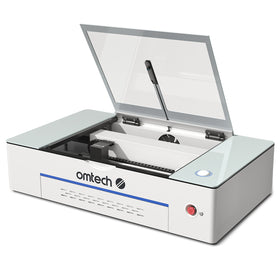
While a CO2 laser routinely relies on swappable glass lenses, a fiber laser uses high-speed galvo lenses, and diode lasers are bounded by a fixed rectangular physical emitter.
Best Focal Lengths by Laser Engraver Type
| Machine Type | Application | Recommended Focal Length | Why It Works |
| CO2 Laser | High-Detail Engraving | 1.5" Lens | Yields an incredibly tiny, sharp dot size (~0.08mm) for photo engraving or micro-text. |
| CO2 Laser | Balanced Daily Use | 2.0" or 2.5" Lens | Standard "sweet spot" for alternating between thin wood cutting and standard text engraving. |
| CO2 Laser | Deep Material Cutting | 4.0" Lens | Provides an expanded Depth of Field (~10 mm+) so the vertical beam profile stays straight, without tapered edges. |
| Fiber Laser | Detailed Coin Engraving | F=160mm Lens | Creates a compact workspace grid (typically 110x110mm), focusing energy into a minute dot for ultra-deep 3D coin etching. |
| Fiber Laser | Bulk Panel Marking | F=290mm or F=420mm | Expands the physical marking footprint over a massive area, though it requires a much taller Z-axis column to focus. |
| Diode Laser | Mixed Materials | Fixed (Approx. 20mm-40mm) | Diodes use built-in fixed configurations; users generally rely on aluminum focus spacer blocks or built-in kickstands to set height. |
How Laser Machine Architecture Binds Your Focal Length
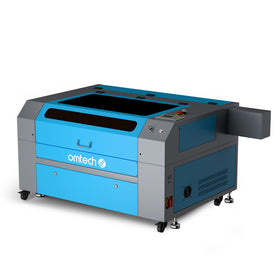
- CO2 Gantry Lasers: These machines bounce the beam through mirrors into a laser head containing a loose meniscus or plano-convex lens. This makes changing focal length incredibly easy. You simply drop in a different optic slice, such as a Cloudray ZnSe Lens.
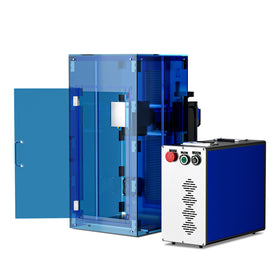
- Fiber Galvo Lasers: Fiber lasers use a fixed "Galvo" scanning head where stationary internal mirrors shift rapidly to angle the beam through a large F-Theta lens. Focal length changes require swapping the entire threaded F-Theta lens assembly, which fundamentally alters your overall maximum marking area.
- Diode Lasers: Consumer diodes typically feature a fixed lens sealed inside a compact housing directly beneath the moving laser module. Adjusting the focus is constrained to moving the entire module up or down on its Z-axis, rather than exchanging the glass itself.
Setting Focal Length For Different Types of Laser Engraving Materials
One of the most important factors to consider when setting focal length is the material you are engraving. That is because different materials vary in three significant physical traits: thickness, texture flatness, and the required detail density of the composition.
How accurately you can match the lens's depth of focus (DoF) to the material's structural density dictates whether you get pristine finishes or scorched errors.
Best Focal Lengths for Common Materials
1. Wood (Plywood, MDF, Hardwoods)
- Best for engraving: 2.0" Lens. Wood fiber resolution maxes out around 254 PPI; any smaller spot size from a shorter lens won't show extra detail due to grain burn bleed.
- Best for cutting (up to 1/4" / 6mm): 2.0" or 2.5" Lens. Balances speed and vertical parallelism.
- Best for cutting thicker wood (1/2"+): 4.0" Lens. Gives you the extended reach needed to punch deep down into the grain without catching fire.
Wood produces heavy smoke and soot, and is prone to warping (uneven height profiles).
2. Acrylic (Cast and Extruded)
- Best for engraving: 1.5" or 2.0" Lens. To achieve fine, bright vector lines or frosted graphics, you need a high-power concentration.
- Best for structural cutting: 2.5" Lens (Thin) or 4.0" Lens (Thick). Acrylic cuts best when the focus is set 1/3 to 1/2 way down into the sheet, which keeps the vertical walls straight and reduces flaring.
Acrylic requires consistent, deep heat to create a flame-polished edge when cutting, or a crisp frosty look when engraving.
3. Slate, Stone, and Ceramic Tiles
-
Best lens choice: 2.0" Lens. It offers a small enough dot to fracture glass/ceramic glazes sharply while retaining enough depth of field to absorb minor stone surface bumps without turning blurry.
Slate is rarely perfectly flat, and ceramic glazing needs immediate, high-intensity shock to fracture or whiten cleanly.
4. Leather and Textiles
-
Best lens choice: 1.5" or 2.0" Lens. A short focus allows you to move at extremely high speeds with lower power settings. This minimizes the heat-affected zone, preventing melted or burnt fabric edges.
Leather burns quickly, creating sticky residue and intense odors if overexposed to heat.
Direct Strategy Comparison
| Material Goal | Best Lens Choice | Focus Placement Strategy |
| Fine Text / Photo Prints (Any flat material) | 1.5" Lens | Perfect zero on top of the surface. |
| Bowed Wood / Organic Stone | 2.5" Lens | Focused on the average middle height of the warp. |
| Thick Acrylic Block Cutting | 4.0" Lens | Dropped 3mm to 5mm inside the material body. |
Your Guide to Laser Focusing — Conclusion
We have done our best to highlight laser focusing and its relation to some factors considered above. More so, these lenses and their focal length always determine the quality of the laser beam available for engraving. In general, ensure you do your homework and define your expectations before purchasing a laser engraver. OMTech has the best CO2 and fiber laser machines with the appropriate accessories for optimal results and marking quality. Our doors are wide open to receive you for demonstration and consultancy at our Southern California showroom.