How To Buy The Best Fiber Laser Engraver For a Jewelry Business
Jewelry engraving is one of those specialized applications that not every laser engraver is suitable for. When choosing a fiber laser engraver for jewelry, pay particular attention to the laser source, output power, optics, positioning system, rotary compatibility, software, and safety features. These determine how effectively your machine can handle small, intricate, and often expensive metal pieces.
It should be to choose a machine that:
- has all the key features to handle the specific metals and jewelry designs you intend to produce
- offers enough flexibility to accommodate more demanding projects as your business grows.
Here are seven essential features to look for, additional accessories worth considering, and some fiber laser engraver recommendations that can help you get started.

Seven Must-Have Features for a Fiber Laser Engraver for Jewelry
1. MOPA Fiber Laser Source
For jewelry laser engraving, you need a MOPA fiber laser, as opposed to a standard Q-switched fiber laser. In fact, whether the machine is MOPA or non-MOPA should be one of your first considerations when buying a machine for jewelry engraving.
Unlike standard Q-switched fiber lasers, MOPA lasers allow you to adjust pulse duration and frequency independently. This gives you greater control over how laser energy interacts with the metal surface.
Why does MOPA matter for jewelry?
A MOPA laser provides the flexibility to experiment with different pulse settings and achieve a wider range of surface finishes. Gold, silver, stainless steel, and titanium can require different engraving settings to achieve the desired finish. While engraving jewelry, you may want:
- a crisp, dark engraving on a silver pendant,
- a detailed pattern on a stainless steel ring,
- or a colored marking on titanium.
It is also useful when working with thin jewelry components where excessive heat can cause discoloration or deformation.
Choose a machine with a genuine JPT MOPA laser source. Check its pulse-width and frequency ranges rather than relying solely on the manufacturer's stated wattage. A source offering approximately 1–4,000 kHz frequency and 2–500 ns pulse-width adjustment provides considerable flexibility.
2. Appropriate Laser Power: 30W to 100W
Making sure you choose the appropriate laser power is also very important when it comes to choosing a laser engraver for jewelry. For jewelry businesses, the right wattage depends on whether you primarily mark surfaces, perform deeper engraving, or cut precious-metal blanks.
- 20W–30W fiber lasers: Suitable for surface marking, names, logos, serial numbers, and relatively shallow designs.
- 50W–60W fiber lasers: A better choice for businesses combining detailed surface marking with deeper engraving, relief designs, and more demanding metalworking.
- 100W MOPA fiber lasers: Better suited to heavier jewelry engraving and businesses that regularly process thicker precious-metal blanks.

Why You Need More Power For Gold, Silver and Copper Jewelry
Gold, silver, and copper are particularly challenging because they reflect infrared laser energy more readily than materials such as stainless steel. Their thermal conductivity also affects how heat spreads during processing.
What this means is that deeper engraving and cutting of gold, silver, and copper can require more passes and careful parameter adjustments. A higher-powered machine can reduce processing time for these demanding jobs.
- If you primarily personalize existing jewelry, a 30W or 60W MOPA machine may be sufficient.
- If you intend to produce signet rings, deep-relief designs, or custom precious-metal blanks, consider 60W or 100W.
The key is to choose according to your most demanding regular application, not just your easiest jobs.
3. Rotary Axis Compatibility
For jewelry laser engraving, you need a fiber laser that is compatible with a rotary axis attachment. A rotary attachment allows the laser to mark curved surfaces while maintaining consistent alignment. This is particularly useful when engraving names, dates, patterns, and decorative borders around wedding bands.
Remember, jewelry engraving is not limited to flat surfaces: you will work with a lot of rings, bracelets, bangles, and other cylindrical pieces that require a machine that can rotate the workpiece during engraving.
For example, when engraving the outside of a ring, you need the machine to follow its curved circumference. Without a rotary attachment, you would need to reposition the ring manually, and it is virtually impossible to maintain consistent spacing and alignment.
So, choose a fiber laser with a compatible rotary connection and support for a three-jaw chuck. Make sure the attachment can securely hold different ring and bracelet sizes. A dedicated jewelry chuck is preferable to a standard roller rotary designed primarily for cylindrical drinkware.

4. A Small Field Lens and Short Focal Length
For jewelry engraving, smaller laser engraving lenses are particularly useful because they concentrate the laser into a smaller working field, which will help you produce finer details.
For context, the field lens of a laser engraving machine determines the marking area and influences the laser spot size and achievable detail.
So, let's say you were engraving a tiny hallmark inside a ring or adding a detailed pattern to a small pendant. Here, you can see how a large marking field may be convenient for processing multiple pieces, but it is not necessarily the best choice when maximum detail is your priority.
Field Lens Sizes For Jewelry Laser Engraving Machines
- 70mm × 70mm: Suitable for very small, detailed engraving applications.
- 110mm × 110mm: A useful option for detailed jewelry engraving and small components.
- 150mm × 150mm lenses or larger: Better suited to larger pieces and batch marking.
A smaller field lens can produce a finer spot, depending on the optical configuration. However, the working area also becomes more limited.
Prioritize a 110mm × 110mm lens or smaller for intricate jewelry work. If you regularly process larger batches, consider keeping a second, larger lens available for wider coverage.
5. Precise Positioning, Red-Dot Guidance, and Autofocus
A fiber laser engraving machine with a reliable positioning system helps you place the design exactly where it needs to appear. This is particularly important when engraving initials, dates, hallmarks, and decorative patterns on small rings and pendants.
Jewelry pieces are often small, expensive, and difficult to position accurately. Even a minor alignment error can ruin a personalized product.
- Red-dot guidance helps you preview the engraving area before activating the laser.
- Dual-red-dot systems can also help establish the correct focal distance by aligning two visible pointers.
Autofocus is another useful feature because different jewelry pieces have different heights and shapes. Instead of manually measuring the distance every time you change a workpiece, an autofocus system can simplify the process.
Choose a machine with visible red-dot positioning, clear preview functionality, and reliable focusing adjustments. If available, prioritize autofocus or a motorized Z-axis that makes it easier to adjust working height between different pieces.

6. Compatible and Flexible Engraving Software
The software controlling your laser is just as important as the hardware, and this is very true when choosing a laser engraver for jewelry.
Jewelry engraving often involves intricate vector designs, small lettering, detailed patterns, and precise positioning. You need software that can handle these designs without restricting your ability to adjust engraving parameters.
The three most popular software programs are:
- EzCad2
- EzCad3
- LightBurn.
These programs support different workflows and offer tools for importing artwork, configuring engraving settings, and managing production.
For example, you may need to import an SVG design for a pendant, adjust hatch angles for a filled engraving, or rotate a pattern to follow a curved surface.
Verify that the machine supports the software you intend to use and that its controller is compatible. Check support for common laser engraving file formats such as SVG, DXF, AI, and other vector and image formats. Avoid machines that restrict you to proprietary software with limited access to laser parameters.
7. Proper Safety Enclosure and Fume Management
Safety is particularly important when engraving precious metals. Remember, fiber lasers operate at approximately 1064nm, an infrared wavelength that is invisible to the human eye. Direct exposure and dangerous reflections can cause serious eye injuries.
- An open-frame fiber laser is therefore out of the question for jewelry engraving unless you have appropriate protective measures, including correctly rated laser eyewear and controlled access to the working area.
- Metal engraving and deeper processing can also produce fine particulate matter and fumes. When working with valuable metals, these particles represent both a health concern and a potential loss of recoverable material.
Look for a fully enclosed machine with appropriate laser safety interlocks, particularly in a jewelry storefront or shared workshop. If you choose an open-frame split-tower machine, install a suitable safety enclosure and use appropriate protective eyewear.
Also, invest in effective fume extraction and filtration designed for metalworking applications.
Pre-Purchase Checklist For a Fiber Laser Jewelry Engraver
Before buying, confirm that the machine meets your jewelry engraving needs:
- ☐ Laser source: Verify the source model and its adjustable pulse-width and frequency ranges.
- ☐ Laser power: Choose power suited to your materials, engraving depth, and production volume. Request sample engravings.
- ☐ Rotary compatibility: Confirm support for a rotary attachment and chuck suitable for your rings, bracelets, or bangles.
- ☐ Lens and marking area: Check that the lens provides the detail and working area your designs require.
- ☐ Positioning and focus: Look for engraving previews, positioning guides, and a focusing method that suits your workflow.
- ☐ Software compatibility: Verify that your machine’s controller supports your preferred software and required features.
- ☐ Safety and extraction: Check for an appropriate enclosure, safety interlocks, and effective fume extraction.
Optional Accessories
- ☐ Non-marring jewelry jigs or precision vises
- ☐ Compatible tilting rotary chuck
- ☐ Motorized Z-axis, if not included
- ☐ X-Y positioning table
- ☐ Compatible foot pedal

Explore The Best Fiber Laser Engraver for Jewelry Businesses
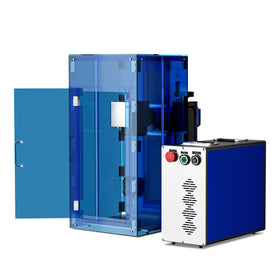
OMTech offers MOPA fiber laser engravers that provide the pulse control, engraving precision, and metalworking capabilities required for different jewelry applications. Two options worth considering are the OMTech MOPA 60W and OMTech MOPA 100W split fiber laser engravers.
OMTech MOPA 60W Split Fiber Laser Engraver
The OMTech MOPA 60W Split Fiber Laser Engraver is a versatile option for jewelry businesses that need to combine detailed surface marking with deeper engraving. It uses a JPT MOPA laser source with adjustable frequencies from 1–4,000 kHz and pulse widths from 2–500 ns. This gives you considerable flexibility when working with different metals and surface finishes.
Its 6.9" × 6.9" (175mm × 175mm) working area provides room for individual pieces and small production batches. The machine also offers a maximum marking speed of 10,000 mm/s.
Other useful features include:
- Air-cooled laser system.
- Red-dot positioning guidance.
- Rotary-axis compatibility for rings and other curved objects.
- Compatibility with EzCad2.
- A stated mean time to failure of 100,000 hours for the laser source.
- Two-year machine warranty.
For jewelry applications, consider adding a 110mm × 110mm lens to achieve a smaller working field for intricate designs and detailed engraving. The open split-tower configuration also makes it easier to accommodate specialized holding fixtures, miniature vises, and tilting rotary attachments.
Overall, the OMTech MOPA 60W is a good choice for growing jewelry businesses that need flexibility without investing in a higher-powered machine they may not fully utilize.
OMTech MOPA 100W Split Fiber Laser Engraver
The OMTech MOPA 100W Split Fiber Laser Engraver is designed for more demanding metalworking applications. It uses a 100W JPT MOPA laser source with adjustable frequencies from 1–4,000 kHz and pulse widths from 2–500 ns.
Its most useful advantage for jewelry businesses is the additional power available for deeper engraving and processing thicker precious-metal blanks. This can help reduce the number of passes and processing time compared with lower-powered machines.
The machine also includes two field lenses: a 110mm × 110mm lens and a 175mm × 175mm lens. This is particularly useful because you can switch between a smaller field for detailed jewelry work and a larger field for wider marking applications.
Other features include:
- Maximum marking speed of 10,000 mm/s.
- Red-dot positioning guidance.
- Air cooling.
- Rotary-axis compatibility.
- EzCad2 software compatibility.
- A stated mean time to failure of 100,000 hours for the laser source.
- Two-year machine warranty.
For a jewelry manufacturer regularly producing deep-relief designs, engraved signet rings, and thicker metal components, the additional power can make a meaningful difference to production efficiency.

7 Key Tips for Buying a Fiber Laser Engraver for Jewelry
Before purchasing, keep these practical tips in mind:
- Prioritize the laser source over the machine's exterior. A well-built cabinet is useful, but the quality and capabilities of the internal MOPA source have a much greater influence on engraving performance.
- Request sample engravings on your actual materials. Do not rely entirely on demonstrations involving stainless steel. Ask to see results on the gold, silver, or titanium you intend to process.
- Buy the right lens for your applications. A 110mm lens is a useful starting point for fine jewelry engraving. Consider a smaller lens for particularly intricate work and a larger one for batch marking.
- Invest in jewelry-specific rotary attachments. A standard rotary may work for cylindrical objects, but a three-jaw chuck with a tilting base is much more practical for engraving the inside of rings.
- Budget for precision fixtures. Holding small pieces securely is essential. A miniature vise, adjustable jig, or suitable thermoplastic fixture can prevent expensive mistakes.
- Do not overlook metal recovery. If you regularly engrave or cut gold, silver, and platinum, consider a dedicated extraction and collection setup that allows valuable metal particles to be recovered for refining.
- Test your settings before processing valuable pieces. Use inexpensive samples to establish suitable frequency, pulse width, speed, and power settings before engraving customer jewelry.

Which OMTech Fiber Laser Should You Choose For Jewelry?
| Business Requirement | Recommended Machine |
| Personalized jewelry and surface marking | OMTech MOPA 60W |
| Fine lettering and intricate designs | OMTech MOPA 60W with 110mm lens |
| Custom rings, pendants, and bracelets | OMTech MOPA 60W with rotary attachment |
| Deep engraving and 3D relief designs | OMTech MOPA 60W or 100W |
| Regular processing of thick precious-metal blanks | OMTech MOPA 100W |
| Higher-volume jewelry manufacturing | OMTech MOPA 100W |
| Businesses requiring flexibility across different marking areas | OMTech MOPA 100W |
Final Thoughts
Choosing the best fiber laser engraver for a jewelry business requires you to look beyond wattage and advertised engraving speeds. You need a machine that can handle the metals you work with, produce the level of detail your customers expect, and accommodate the different shapes and sizes of jewelry pieces.
For most growing jewelry businesses, a 60W MOPA fiber laser offers a strong balance of precision and processing capacity. If your work involves regular deep engraving, thicker precious-metal blanks, or demanding production schedules, a 100W MOPA machine may be a better investment.
Ultimately, remember that choosing the best laser engraver for a small business is always about deciding on the one that fits your current production requirements while giving you the flexibility to take on more demanding jewelry engraving projects as your business grows.