Fibre Laser Technology: How Fibre Laser Engravers Work
Fibre laser engravers focus a beam of light through a fibre-optic cable to create permanent marks on metals and some plastics. Learn everything you need to know about fibre laser technology and machines here!
What Is a Fibre Laser Engraver?
Fibre laser engravers are used to create permanent marks on metals and some plastics. During the engraving process, a focused beam of light is sent through a fibre-optic cable and used to mark the material’s surface. The surface absorbs the laser, melts, and discolours. Fibre laser engravers are also known as fibre laser marking machines. They’re widely used by makers and manufacturers to create custom designs and personalised items, and to mark product parts for identification and traceability.
What do fibre markers do?
Fibre-optic lasers are precision machines used for marking, cleaning, and texturing, among other tasks. Fibre laser marking machines are used across all industries, including aerospace, dental, medical, automotive, jewellery, scientific, and sensor fields. The flexible fibre-optic cable enables extreme precision and fast working speeds.
Manufacturers often use fibre laser markers to identify products — such as car parts or medical devices — so they can be easily traced. However, makers and small businesses also use fibre laser markers to create unique products. From wedding gifts to promotional items, a fibre laser engraver can be used to produce personalised items and artwork across a wide range of materials.

While fibre laser technology is extremely versatile, it’s important to differentiate between a fibre laser engraver and a fibre laser cutter. Fibre laser cutters are far more powerful than fibre laser engravers because they use a more intense, tightly focused laser source. A fibre laser engraver produces a wavelength between 800 and 2,200 nm, while a fibre laser cutting machine operates at a wavelength between 9,000 and 11,000 nm. While it’s possible to cut metal with a fibre laser marker, you would need a laser source of around 2,000 watts. A standard DIY fibre laser machine has 20 to 50 watts of power.
How Does a Fibre Laser Work? What is fibre laser technology?
All lasers have three main components — an energy source, a laser medium, and an optical resonator. The energy source, or pump source, is where a laser gets its energy. The laser medium, also called the gain medium, determines the laser’s wavelength. Many different laser media can be used as the base of a laser. The optical resonator, or optical cavity, reflects the light so it feeds back into the system.
A fibre laser uses a low-maintenance laser source to generate a laser beam that travels through a “doped” fibre-optic cable to the beam head. A doped fibre-optic cable contains ions from rare-earth elements such as ytterbium. These elements improve the fibre’s efficiency and performance. The beam head contains a beam expander and a lens. This is the part that actually performs the marking.
Laser marking machines expose materials to a low-powered beam. This doesn’t change the properties of the material, but instead uses a process called laser coloration on the surface to create high-contrast marks. Using software such as EzCad, fibre laser markers can create detailed text, images, or patterns based on your designs
How fibre laser sources work
The source of a laser beam in a fibre laser machine is the pump source. The pump source is made up of laser diodes that convert electricity into light. The diodes contain two semiconductors with opposite electrical charges. When these opposite charges meet, they release a free electron that then emits a photon. These photons build up as electricity passes through the diodes. The photons are then pumped into the doped fibre-optic cable that generates the laser beam.
The galvanometric drive system
There are several ways to direct the laser beam once it’s created by the laser source. While flatbed laser machines use motorised belts to move the laser beam with fixed mirrors, the galvanometric drive system uses high-speed, motor-driven mirrors to guide the beam through its lenses. Because there are no belts and the only moving parts are the mirrors, the laser beam can move at high speeds in an easily repeatable way. With galvanometric machines, you can achieve high-quality marking results with short cycle times while using less production space.
Fibre laser F-theta scan lenses
The laser beam created with a galvanometric drive system moves in one or two dimensions. With a traditional lens, the beam’s focal point changes as the beam moves away from the optical axis. This shift in focal point can lead to defects in your projects. F-theta lenses correct this by focusing the laser beam onto an image plane without distortion.
F-theta lenses are often used in galvanometric scanning systems made up of two mirrors. One mirror controls beam deflection in one direction and the other controls beam direction in the perpendicular direction. The F-theta lens then focuses the laser precisely on the planar surface.
Autofocusing Precision
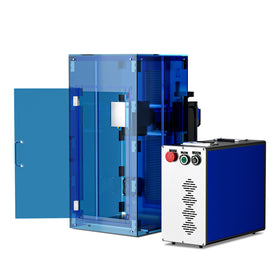
Newer fibre marker models may include an autofocus function, allowing users to achieve the ideal focal length on a variety of materials at the press of a button. The new OMTech Autofocus Fibre Laser Markers make focusing your projects a breeze, offering convenience and instant focus.
Fibre Lasers vs. CO2 Lasers

CO2 lasers and fibre lasers perform best on different materials of different thicknesses. The main difference between the two is how they create and transmit laser beams. CO2 lasers work by using CO2 gas to split light particle ions. These particles collide with each other, splitting even further. A pair of lenses then reflects and refocuses the light down a “beam delivery system” to the cutting head. When the light reaches the cutting head, it’s refocused and emitted to either mark or cut. The light emitted by a CO2 laser has a longer wavelength than the light emitted by a fibre laser.
CO2 lasers have been around longer than fibre lasers have been in use — for over 30 years — but fibre lasers are quickly catching up in frequency of use. One advantage fibre lasers have over CO2 lasers is cost. Fibre lasers are more efficient and cost less to operate. They’re also easier to maintain, making them an attractive option for small businesses and makers. CO2 lasers perform better on thicker materials. Fibre lasers, on the other hand, have a clear advantage on thinner materials and work much faster.
Is a fibre laser better than a CO2 laser?
Fibre lasers perform better than CO2 lasers for certain tasks. They produce a more concentrated laser beam, so they’re ideal for jobs that need precise, high-contrast marks. Fibre lasers are much faster than CO2 lasers and cause less damage to surrounding material because they only affect the surface layer. They also take up less space.
CO2 lasers, on the other hand, can be used on a wider range of materials, including glass, plastic, leather, wood, and stone, among others. CO2 lasers also perform better on thicker materials. However, you need to be careful when using CO2 lasers on highly reflective metals, since the laser could reflect back into the machine and damage it.
Ultimately, the choice between a fibre laser and a CO2 laser will depend on several factors, including:
- The type of material you’re engraving
- The thickness of the material you’re cutting
- The volume of marking you’ll be doing
If you’ll mainly be working with metals, hard plastics, or stone, a fibre laser machine may be a better choice. If you’ll be working with wood or other soft or porous materials, a CO2 laser will be your best option. You may also want to choose a fibre laser marking machine if you plan to do a lot of marking, if you need to do it quickly, or if you want a low-maintenance laser engraver.

Which Materials Can a Fibre Laser Engrave or Mark?
Fibre lasers can engrave or mark a variety of materials, but they don’t work on everything. If you want to engrave metal with complex graphic patterns, serial numbers, or barcodes, fibre lasers are an excellent option. They’re also a great choice for jewellery engraving and other hobby projects. Unlike CO2 lasers, you don’t need a bonding solution when you use a fibre laser marker on metal. Fibre lasers work best on hard, brittle materials such as metal, stone, and hard plastics.
Materials you can engrave or mark with fibre lasers include:
- Acrylic
- Hard plastics
- Brick
- Granite
- Marble
- Tile
- Aluminium
- Gold
- Silver
- Stainless Steel
- Brass
- Titanium
- Tungsten
Fibre lasers work well on PVC (polyvinyl chloride) materials. However, some PVC acrylics can create toxic fumes when they’re lasered. PVC is a polymer that contains chloride. Heating PVC breaks it down, causing it to release hydrochloric acid, a toxic gas. If you’re using a fibre laser on PVC, you’ll need to make sure you’re using a trustworthy fume extraction system capable of handling the toxic gas.
Another consideration when using PVC with a fibre-optic laser is dechlorination, a decomposition process that occurs as PVC is heated. When the chlorine is released, it causes yellowing around the area that was marked with the fibre laser.
Can a fibre laser engrave wood?
Fibre laser marking machines cannot engrave wood. Fibre lasers have a shorter wavelength than other types of lasers, which allows the fibre laser to penetrate the wood. This causes heat to build up and will eventually cause the wood to catch fire. This is extremely dangerous, especially because wood can feed a fire.
Additionally, fibre laser engravers don’t produce optimal results on wood. The high intensity of a fibre laser beam makes it difficult to control absorption into porous materials. Since the absorption rate can’t be controlled, the marks a fibre laser produces on wood are unpredictable. Even if your wood doesn’t catch fire, the engraving may be burned in some places and barely visible in others. You won’t be able to achieve precise, repeatable results, which is the main reason most people are interested in a fibre laser in the first place.
Can a fibre laser cut glass?
Fibre lasers can’t be used to cut glass, mainly because of the wavelength of the laser beam they produce. Fibre lasers work by causing a layer of the material they’re marking to absorb the light and melt. Glass absorbs very little light on the visible spectrum, so it isn’t compatible with fibre laser markers.

How Much Does a Fibre Laser Marking Machine Cost?
The prices of fibre laser marking machines vary greatly depending on the source. Many high-end systems cost tens of thousands of dollars. While it’s possible to buy cheap fibre laser machines, they’re often poor quality and either won’t perform well or won’t last long. It’s difficult to find a high-quality machine at an affordable price.
Although large manufacturers can justify spending a large amount of money on expensive machines, small businesses, makers, and hobbyists usually can’t afford to spend $30,000 or more on a fibre-optic laser. OMTech noticed this gap in the market and designed machines meant to provide you with the best quality laser engravers at reasonable prices.
Where to buy a fibre laser marker machine
OMTech is a stand-alone brand that offers quality laser engraving machines at affordable prices. Before starting the brand, OMTech founders had over ten years of experience in the laser engraving industry. They now have laser machines for every need. Whether you’re a hobbyist who needs a desktop engraver or a small business that needs an autofocusing fibre laser engraver, OMTech Laser has the best solution for you.
OMTech builds laser engravers to work intuitively, so you don’t need an engineering degree to use one. You can access advanced laser capabilities at the touch of a button. They understand that laser engravers are an investment, so they also offer financing options for customers. DIY makers and small businesses can now take advantage of flexible payment terms to buy a quality laser engraver.
They’ve built an online community of hobbyists, artisans, and businesses that share laser knowledge and solve problems together. They also provide top-notch customer support so you can get the most out of your laser machine. Reach out to OMTech today to see how they can help you start your laser journey.